

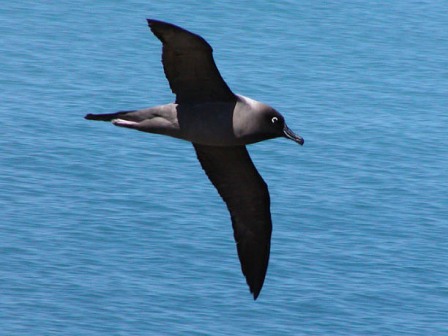
Photo: Michael G. Shepard
"T he ‘albatross with light eyebrows’ taken during Cook’s first voyage in the South Indian Ocean, was an example of this species, and formed the basis of Forster’s description of Diomedea palpebrata published in 1785." The closely related sooty albatross lacks the pale mantle.
Arguably the most beautiful albatross, the light–mantled sooty in New Zealand waters breeds on the Antidopes, Auckland and Campbell Islands. The largest breeding colonies are to be found on South Georgia, the Kerguelen and Auckland Islands.
According to Oliver, it frequents the oceans far from land, only coming ashore to near inaccessible cliffs to breed. This species is perhaps the most perfect glider of all sea birds, it seldom being seen to flap its wings. In flight, the wings are kept straight out from the body without the appearance of being slightly flexed as in the wandering albatross. According to other reports, in flight, the bird has a distinctive cross-like shape which is evident at great distances and on high soaring birds, helping with identification.
"Unlike the true albatrosses and mollymawks, the light-mantled sooty does not breed in large colonies but nests singly on the ledges and slopes of sea cliffs, usually with a cliff above and below so as to be quite inaccessible. Any site will suit so long as it has steeply falling ground below to give room for take off. The birds take off by propelling themselves outward; no run is taken, unlike the true albatrosses. The birds return to their breeding localities during the first week of October. The young leave the nest during the 20th week, that is the third week in May." Light-mantled Sooty Albatross pairs conduct courtship flights in sweeping synchronised loops, frequently swapping the lead as they bank to one side, then the other. They also give an eery call in flight.
The light-mantled sooty is suffering heavily from long line fishing. They are seen to follow ships regularly. They feed mainly on squid.
Recent tracking of light-mantled sooty albatrosses breeding at Macquarie Island with miniaturised satellite transmitters, indicate that birds spent several days foraging before returning to their nests. These flights were at an average distance of 1516 km from Macquarie Island and located in Antarctic waters, mostly along the Antarctic continent. The maximum foraging range was in average 1721 km and the total distance covered by two birds for which there were complete tracks was 6463 and 6975 km. This study confirms previous suggestions that light-mantled sooty albatrosses are able to forage in the waters of the high Antarctic while breeding in the sub-Antarctic. The extreme separation of feeding zones from nesting grounds has implications in terms of conservation and life-history.

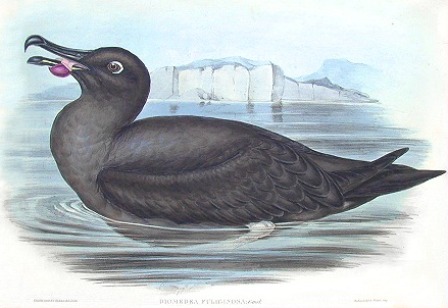
Gould, John, Birds of Australia, 1840-48.
| Taxonomy | |
|---|---|
| Kingdom: | Animalia |
| Phylum: | Chordata |
| Class: | Aves |
| Order: | Procellariiformes |
| Family: | Diomedeidae |
| Genera: | Phoebetria |
| Species: | palpebrata |
| Sub Species: |
Toroa-haunui, blue bird, Toroa-pango.
Native bird
80 cm., 2.75 kg., sooty brown head, blackish on lores; a circle of white feathers almost encloses the eye; mantle ash grey; back and under parts brownish grey; wings dark brown; bill slender and black with blue line along lower bill, legs and feet pale grey.
They range widely in the southern oceans but are occasionaly seen in New Zealand coastal waters and are often beach–wrecked in July–August. Breeding colonies at Auckland, Campbell and the Antipodes.
Soy el albatros que te espera en el final del mundo.
Soy el alma olvidada de los marinos muertos
que cruzaron el Cabo de Hornos
desde todos los mares de la tierra.
Pero ellos no murieron en las furiosas olas,
hoy vuelan en mis alas, hacia la eternidad,
en la última grieta de los vientos antárticos.
– Sara Vial. From an inscription on an albatross scupture at Cape Horn.
I am the albatross that awaits you at the end of the world
I am the forgotten soul of dead sailors who have rounded Cape Horn from
all the seas on earth.
They did not die in the roiling waves;
they fly on my wings
to eternity
along the last rift in Antarctic winds.
— Translation by Lisa Carter
Gould, John, Birds of Australia, 1840-48.
Oliver, W.R.B. New Zealand Birds, 1955.
Heather, B., & Robertson, H., Field Guide to the Birds of New Zealand, 2000.
Wednesday, 2 August, 2023; ver2023v1