

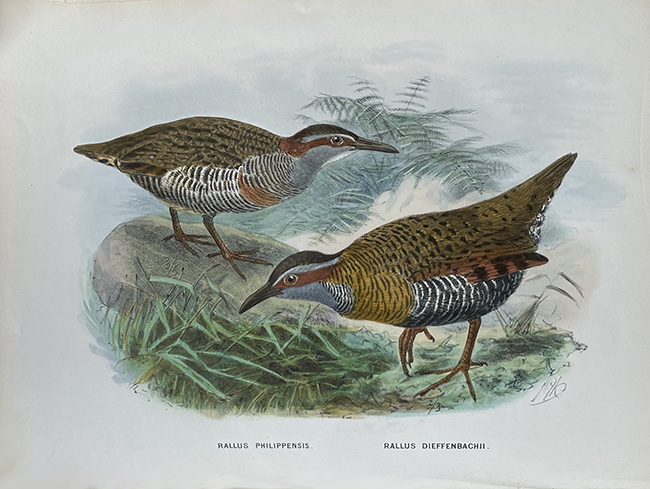
From Buller's Birds of New Zealand, 1873. Banded rails.
L iving as I do on the edge of Ohiwa Harbour, I am always on the lookout for banded rail and marsh crake but am seldom rewarded. One would expect to see numerous members of the rail family around here but even Pukeko are scarce.
The banded rail is, of course, a shy and secretive bird and is best spotted, they tell me, at dawn and dusk or in heavy rain but still I do not think there are very many around here and wonder what one might do to help and encourage them as they are such beautiful birds.
The rails are aquatic birds, all capable of swimming well. In New Zealand, they rangein size from the large flightless Takahe to the small marsh crake and include Weka and the Australasian coot. They have slim bodies that help them move through dense vegetation, moderately long powerful legs with long unwebbed toes that help them walk in wetlands, a short tail which is flicked up and down as they walk or swim and short broad wings.
Banded rail breed in the South Pacific from Indonesia and the Philippines through Melanesia, Australia and New Zealand to as far east as Niue in western Polynesia. The subspecies assimilis is the form found on the New Zealand mainland and dieffenbachi was endemic to the Chatham Islands before being exterminated in the 19th century.
Banded rail are found in mangrove forests, salt marshes and rush covered (not raupo) freshwater wetlands in the northern part of the country. They are relatively rare in the South Island. They were at one time very common in New Zealand. Indeed Charlie Aramoana of the hapu Te Upoko-rehe, Kaitiaki, the guardians of Ohiwa Harbour, tells me that when he was a child 50 years ago, they were running about everywhere, the dogs making great sport of them.
Pairs remain in their territory year after year. They feed on snails, crabs, spiders, beetles and worms, feeding at dawn and dusk and after high tide. They run at great speed but seldom take to flight, although they are more than capable of strong flight as their spread around the Pacific indicates.
That superb observer of our birds, Guthrie-Smith, has said that their reduction in numbers is due to rats eating the eggs. Of 21 nests in one area investigated by Guthrie-Smith, eighteen had been robbed by rats. The other three were close to human settlement. This, to Guthrie-Smith, proved that the household cat was the protector of these birds. That it is recorded as persisting in developed areas also supports this thesis.
Godwit House, Ohiwa Harbour, 2001.

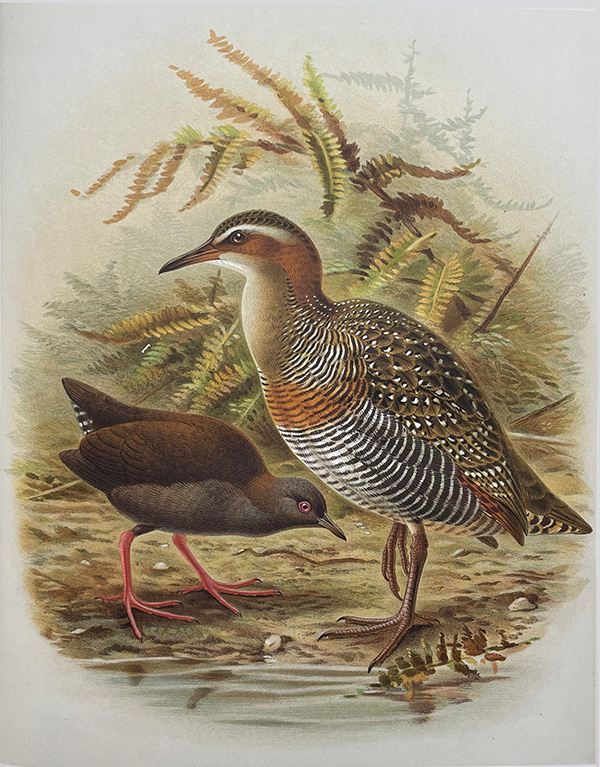
From Bullers's Birds of New Zealand, 1888. Known at that time as the Swamp rail (l) and the Land rail (r). Now known as the Spotless crake (Pūweto) and the Banded rail.
| Taxonomy | |
|---|---|
| Kingdom: | Animalia. |
| Phylum: | Chordata. |
| Class: | Aves. |
| Order: | Gruiformes (Ralliformes). |
| Family: | Rallidae. |
| Genera: | Rallus. |
| Species: | philippensis. |
| Sub Species: | assimilis |
Buff-banded rail.
30 cm, 170 g. Upper surface of the body and wings olive brown spotted black and white; underparts barred black and white; chestnut band across chest and through eye to hindneck; whitish eye stripe; grey chin and throat; long stout reddish brown bill; feet brown; juvenile similar to adult but markings less distinct; nestling covered with sooty black down, feet and bill black.
Northern part of New Zealand. They are rarely recorded south of a line from northern Taranaki to the eastern Bay of Plenty.
Buller, Walter Lawry, Birds of New Zealand, 1st ed., 1873.
Buller, Walter Lawry, Birds of New Zealand, 2nd ed., 1888.
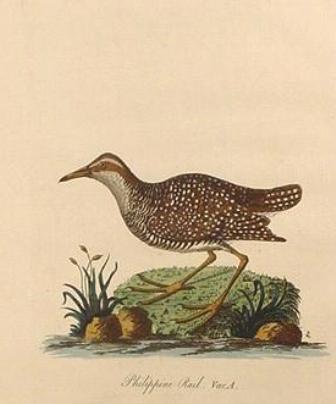
Latham, John, A General Synopsis of Birds published London, 1795.
Guthrie-Smith, H., Sorrows and Joys of a New Zealand Naturalist, 1936.
Heather, B., & Robertson, H., Field Guide to the Birds of New Zealand, 2000.
Oliver, W.R.B., New Zealand Birds, 1955.
Monday, 5 December, 2023; ver2023v1