The cirl bunting is the least known of New Zealand’s introduced passerines as it is not wide spread, its main population being confined to the north of the South Island. However, it may also have crossed the Cook Straits to Lake Wairarapa, although this has not been confirmed. Hutton and Drummond reported in the early part of the 20th century that it was common at Hawera and other Taranaki districts and at several districts adjacent to Christchurch. The Taranaki population seems to have gone.
The only records of the introduction of the cirl bunting to New Zealand are seven birds liberated in Otago in 1871 and four in Wellington in 1880. In 1879, eighteen birds were transferred to Stewart Island.
Its numbers are in decline throughout its range of southern Europe, north Africa and Turkey and is a very rare bird in Britain, now confined to Devon and Cornwall. The New Zealand population could become internationally important and serves to remind that the conservation of birds is an international effort.
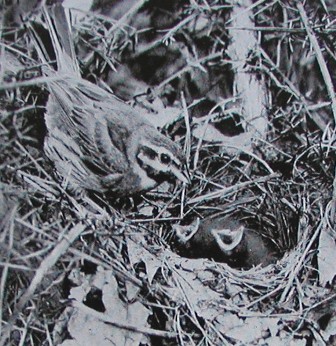
The cirl bunting clutch may be four or five greyish or pinkish white eggs with small pale brown blotches and dark brown lines and spots mainly at the larger end, the size being around 16mm x 20mm. The nest is placed on the ground or in a shrub a few feet from the ground. A nest found in New Zealand is an untidy structure of grass and rootlets lined with fine rootlets and hair.
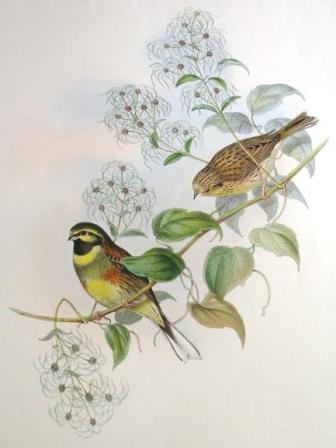
The cirl bunting may be confused with their close relative, the yellowhammer. Cirl bunting females have olive brown rumps while the yellowhammer has a rufous rump. The cirl bunting is also darker with less yellow. The male cirl bunting has a greyish crown with a bold black eye stripe, while the yellowhammer’s crown is yellow. The call is not unlike the yellowhammer’s. RSPB defines the differences as follows: “Male cirl buntings have diagnostic black and yellow faces. The females show hints of this same black and yellow pattern including obvious broad dark lines behind and below the eye. If you are in doubt about whether you have a cirl bunting or a yellowhammer, check the rump colour - grey brown on a cirl bunting, almost red on a yellowhammer. Also, cirl buntings have a small grey shoulder patch and richer chestnut on the upperparts.”
Note: cirl bunting pair sited on Mole Street, Greytown, 2018.
Song: —
Viking Sevenseas
This section should be replaced with an audio player, if not, please select the link below: »»» Song of the Cirl bunting
Other common names: —
french yellow–hammer, black-throated yellowhammer.
Description: —
Introduced bird
16 cm, 25 g; white outer tail feathers, rump greyish olive, adult male distinct black throat.
Where to find: —
Confined to Marlborough and Central Otago.
Youtube video —
Illustration description: —
Gould, John, Birds of Great Britain, 1862–73.
Oliver, W.R.B., New Zealand Birds, 1955.
Reference(s): —
Heather, B., & Robertson, H., Field Guide to the Birds of New Zealand, 2000.
Oliver, W.R.B., New Zealand Birds, 1955.
F.W.Hutton & James Drummond, The Animals of NZ., 1923.
Page date & version: —
Friday, 7 June, 2019; ver2009v1