The crimson rosella is a colourful, if rare, addition to New Zealand’s bird life. It was first seen about 1910 near Dunedin but none have been recorded from that area for over 30 years. Then, in 1963, crimson rosellas, probably cage escapees, became established in the Wellington area. They have since bred successfully. Two birds were also recorded from the Tararua foothills near Eketahuna in 1971. They are now quite numerous there.
In Australia they are forest birds found in tableland not far from the coast. They also live on the outskirts of towns and cities and in orchards, but generally are not common in open or lightly wooded areas. In Wellington, they inhabit parks, reserves and well-timbered suburbs.
Its breeding habits have yet to be studied in New Zealand. In Australia, the breeding season extends from late August to February. The nest is usually a shallow bowl of decayed wood dust in a hollow limb or hole in a tree. The female lays about five white, oval eggs, and incubates for about 21 days. The young fledge after about five weeks and generally remain with their parents for several months longer.
Crimson rosellas are usually seen in pairs or small family group; but in parts of Australia, where they are plentiful, immatures flock in autumn and winter while adults remain in pairs or small parties.
Crimson rosellas feed on a wide variety of grass, shrub and tree seeds, fruits, nuts, flowers, shoots, nectar and insects. The numbers of this richly coloured bird are very low and the range most restricted. Should they become common, however, they are likely to become a pest in major fruit-growing districts.
Other common names: —
Broad tailed parakeet, Pennant’s parakeet, red lory, red lowry, Platycercus pennantii.
Description: —
Introduced bird
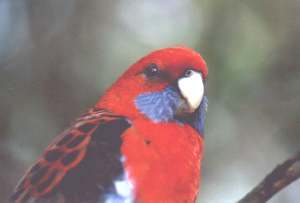
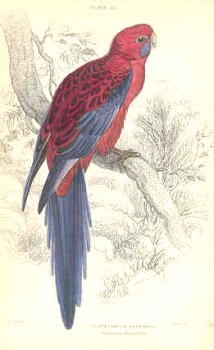
35 cm, 130 g., Crimson with blue cheeks, mottled black on the back; immature, green with red head, breast and undertail.
Where to find: —
Wellington area.
Youtube video —
Credit for the photograph: —
Parrot Society
Illustration description: —
Sir William Jardine’s Naturalist’s Library, 1836. Artist, Edward Lear.
Reference(s): —
Heather, B., & Robertson, H., Field Guide to the Birds of New Zealand, 2000.
Oliver, W.R.B., New Zealand Birds, 1955.
Australian Museum
Reference(s): —
Oliver, W.R.B. New Zealand Birds, 1955.
Heather, B., & Robertson, H., Field Guide to the Birds of New Zealand, 2000.
Page date & version: —
Sunday, 18 May, 2014; ver2009v1