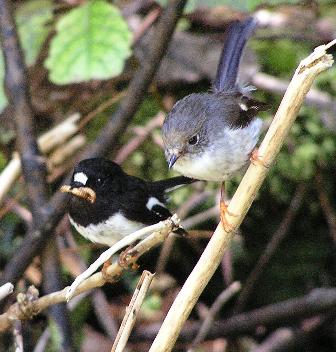
There are five species of this bird, each restricted to an island and its outlying islands; North Island tomtit, toitoi, South Island tomtit, macrocephala, Chatham Island tomtit, chathamensis, Snares Island tomtit, dannefaerdi, and Auckland Island tomtit, marrineri.
Mrs Amy Wilkinson describes the note of the male tomtit on Kapiti Island as a “cheery little song which he repeats without much variation at frequent intervals, chiefly in the spring time. Although it comprises only a few notes, he sings these with so much vigour that it cannot fail to please. The female may very occasionally he heard singing the same short song, but in so low and subdued a tone as to be almost inaudible. She has been heard to give her song only when she is near to or attending her young. The call notes of both are quite surprisingly loud and piercing and repeated rapidly three or four times with widely–opened bill. When nest building is in progress the birds keep in touch with one another with these notes, not nearly so loudly uttered, and using them but singly, one calling and the other answering until they come together.
“One pair of tomtits apparently stay about the same area all their lives and resent the presence of another of their kind within their fenceless domain, the male fiercely chasing the trespasser and causing it to hurriedly take the shortest cut home. The range of the tomtit’s territory is quite extensive, maybe ten or more acres.
“Nesting operations begin rather early in the season, sometimes during the last week in August. Often a hole in a tree is chosen, sometimes a sheltered cleft in a bank or rock, and sometimes a tree, generally a low and compact one. The nest appears to be entirely built by the female, the male supplying her with food while she works. He helps her to select the site and it is amusing to watch him pop into a hole in a tree and hear him calling to his mate to come in and inspect it also. He has been seen, too, to sit in a nest she had built and then discarded, perhaps to test it and tempt her back to it again, or reassure her of its suitability.
“The material used for the construction of the nest is principally moss and soft scraps of thin bark bound together with cobwebs and feathers. Three or four eggs are usually laid; white with a liberal spotting of tiny dark specks, mostly at the larger end. The hen does most, or probably all, of the incubating. She leaves the eggs frequently in response to a call from her mate, at about quarter–hour intervals, when he carries food to her. He puts the food — an insect of some kind — into her mouth, she fluttering her wings in a manner of young birds when being fed.
When the young are hatched, both parents carry food. Sometimes the male will give his catch to the female to feed to them. He is often more cautious about approaching the nest when under observation than she is. She will fly up courageously, making angry little snapping noises, with erected head feathers and ruffled wings, darting swiftly past and almost touching one’s face, sometimes even alighting on the intruder’s head or shoulders, and finally slipping on to the nest, covering the eggs or young. This is real bravery and cannot but excite real admiration for the small grey bird. At other times, when not having young to defend, the female tomtit is a retiring little bird, and does not very often venture from her bush retreat or bring herself into notice.
— Narena Olliver, Greytown
Song of: — Miromiro, the tomtit
Viking Sevenseas
Other common names: —
Great headed titmouse, pied tit, Ngiru-ngiru, yellow-breasted tit, black tit, Maui Potiki.
Description: —
Endemic bird
13 cm., 11 g., large head, short tail, sub species vary in size and colour, the Snares being totally black; North Island has black head with white spot above bill, black upperparts and upper breast, white underparts, white wing bar and sides to tail; South, Chatham and Auckland Islands similar but with yellow breast; adult females have brown head and upperparts.
Where to find: —
Widespread in forested areas but not common.
More Information: —
Miromiro on the Maori myth page
Illustration description: —
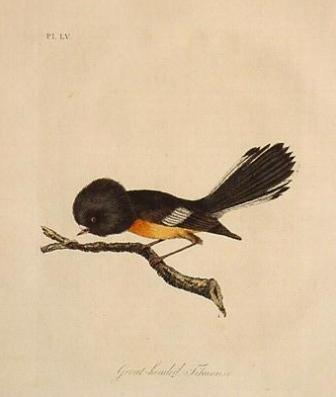
Latham, John, A General Synopsis of Birds, 1795.
Reference(s): —
Heather, B., & Robertson, H., Field Guide to the Birds of New Zealand, 2000.
Oliver, W.R.B. New Zealand Birds, 1955.
Page date & version: —
Wednesday, 17 July 2019; ver2009v1