More than a week of severe storms blowing up from the Antarctic has left thousands of sea birds wrecked across New Zealand, not just along the coast but well inland. A local landowner brought in a bird for me this morning, wanting me to help indentify it. After much measuring of the dead bird and consulting of the identification guides, we determined quite confidently that it was a broad-billed prion, and not an antarctic prion which were being reported as being wrecked in large numbers in and around Wellington. The local bird rescuer, the reverend Robin List, confirmed that all the birds he had coming in from around the Wairarapa were broad-billed. So.
A wreck is when very large numbers of seabirds die and become wrecked around the coast. Sometimes it involves mainly one species, or at other times several species. Some wrecks seem to be caused by storms catching young birds a few days after leaving their nests, others by storms combined with a food shortage. Birds found dead or dying on the beaches are usually only a small fraction of what is occurring at sea. New Zealand lies in the path of seabirds moving eastward in winter from the southern Atlantic and Indian Oceans. Wrecks of 13,000 prions that came ashore in New Zealand during June and July 1964 showed obvious signs of starvation as did a wreck of prions that occurred in 1981 in South Africa and in Chile in 2007. Analysis of dead birds washed up on the world's coasts remains one of the main ways of studying seabird movements throughout the year. The El Nino/Southern Oscillation, a warm water Equatorial current that irregularly flows south along the Chilean and Peruvian coasts is well known to disrupt marine and terrestrial ecosystems and to raise havoc among some seabird populations.
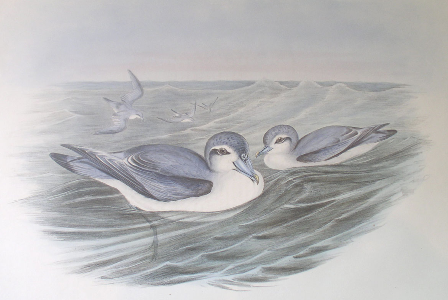
Prions are small birds with blue-grey colouring. The broad-billed prion is characterised by its large broad bill and is found throughout oceans and coastal areas in the Southern Hemisphere. Its colonies can be found on many islands around the coast of New Zealand, in Fiordland, Solander Islands, Foveaux Strait, the Chatham Islands and sub-Antarctic Antipodes Islands.
The broad-billed prion was observed off the East Cape in 1769 during Cook's first voyage and again at Dusky Sound in 1773 by Forster, during Cook's second voyage.
The broad-billed prions diet consists mainly of planktonic crustaceans, but, like other Antarctic prions, it uses its special bill to filter this food from the water. The bill has comb-like fringes called lamellae, similar in principle to the filter plates of baleen whales. It feeds by running across the ocean surface with its bill open under water, moving its head from side to side and skimming for food.
Breeding begins on the coastal slopes of the breeding islands in July or August. The parents incubate the egg for 50 days, and then spend another 50 days raising the chick. Colonies disperse from December onwards.
The prions belong to the Procellariiformes, which were formerly called Tubinares, or tubenoses, and now are generally called petrels. They are almost exclusively pelagic and have a cosmopolitan distribution across the world's oceans, with the highest diversity being around New Zealand.
Procellariiformes have an enlarged nasal gland at the base of the bill, above they eyes. This gland rids the birds of the salt they ingest from sea water. Scientists are uncertain of its exact processes.
— Greytown, 2011
Other common names: —
whalebird, scooper, blue-billy.
Description: —
Endemic bird
28 cm., 200 g., blue-grey upperparts, a dark face, white eyebrow, a black "W" on the wings, a black tail tip, and white underparts, massive bill. The head pattern is more distinct and the tail band is less extensive than that of the similar Fairy Prion.
Where to find: —
Main colonies are in Fiordland, Foveaux Strait, off Stewart Island, the Snares, and Chatham Islands.
Illustration description: —
Gould, J., Birds of Australia, 1840-48.
Reference(s): —
Heather, B., & Robertson, H., Field Guide to the Birds of New Zealand, 2000.
Readers Digest Complete Book of NZ Birds, 1985.
Olliver, W.R.B., New Zealand Birds, 1955.
Page date & version: —
Sunday, 1 June 2014; ver2009v1