

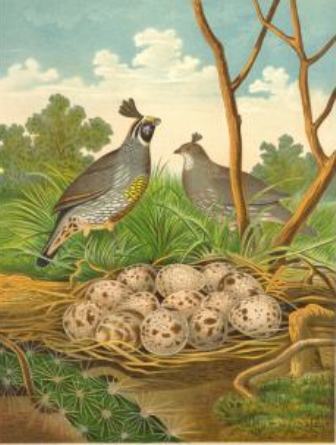
Gentry, Thomas, Nest and Eggs of Birds in the United States, 1882.
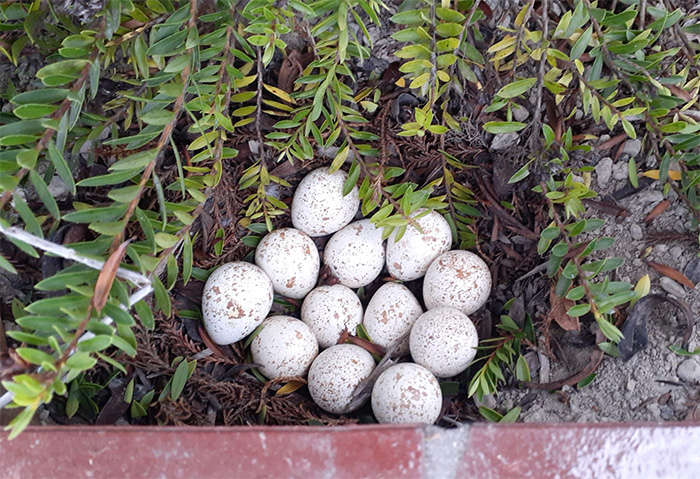
Nest and Eggs of Californian Quail in Waikanae, New Zealand, 2024. Well spotted and photographed by Sigi Scrase.
Coveys break up in late winter and birds pair off from around late August.
“The nest is considered most difficult to find. In fact the only chance of coming across it is by accidentally flushing the sitting bird, which often rises at your feet. The nest itself is a simple affair, a hollow in the ground lined with grass and made comfortable for the big batch of eggs. In most cases there is a canopy of grass over the nest, which must be as cosy as any nest could be. A site in the midst of long grass, under a log or small bush, perhaps a straggling blackberry, is usually selected.
“The laying season is mainly October, November and December. A clutch of 12 to 16 eggs may be laid. The eggs are creamy white, spotted dark and yellow brown, the size being 32 x 25 mm. The period of incubation is about 23 days and this duty is carried out by the hen bird.
“As soon as they are hatched, the tiny chicks are on the run, disappearing into the grass when the alarm is called by the hen. When danger has passed, they are called together again by the hen. In this way at least a few of the large brood escape predators.”
The chicks, in their first few weeks, eat mainly small insects, moving onto an adult diet of seeds of a wide variety of plants together with the leaves of clover and other grasses.
— Narena Olliver, Greytown, Wairarapa, 2007.

The Waikanae eggs have hatched. The video is long and wonderful. There is the occasional glimpse of the adult. Thank you Geoff Scrase for "capturing" the "bumble bees".
| Taxonomy | |
|---|---|
| Kingdom: | Animalia |
| Phylum: | Chordata |
| Class: | Aves |
| Order: | Galliiformes |
| Family: | Phasianidae |
| Genera: | Callipepla |
| Species: | californica |
| Sub Species: | californica, brunnescens |
California partridge
Introduced bird
25 cm., 180 g., brown with foward curving top knot, male has black throat.
Relatively common throughout New Zealand, in less developed areas.
California Quail
LINK to California Quail MAIN page
Poetry: —
California quail
Between Yumbel and Cuatro Trigos I saw a shadow, a shape, a bird
slipping away with its beauty,
a fruit, a feathered flower,
a bird of pure pear,
a circumstance of the air,
a sandy smoky egg:
I approached - called out, its eyes
shone with the hostile rectitude
of two flaming lances
and above its pride it wore
two plumes like two banners;
I had no sooner seen
that vision than it vanished
and I was left with the dusk,
with the smoke, the haze, and the night,
with the solitude of the road.
— Pablo Neruda, The Art of Birds,
(translated by Jack Schmitt).
The eggs: Sigi Scrase
The video: Geoff Scrase
Gentry, Thomas, Nest and Eggs of Birds in the United States, 1882.
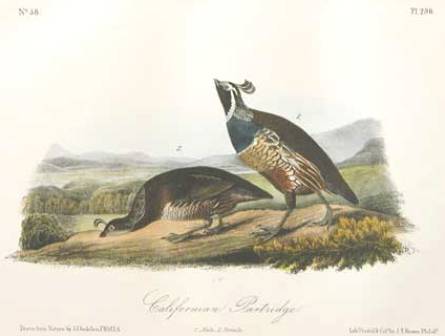
Audubon, John James, Birds of America, 1840.
Oliver, W.R.B. New Zealand Birds, 1955.
Heather, B., & Robertson, H., Field Guide to the Birds of New Zealand, 2000.
Monday, 26 February, 2024; ver2023v1