

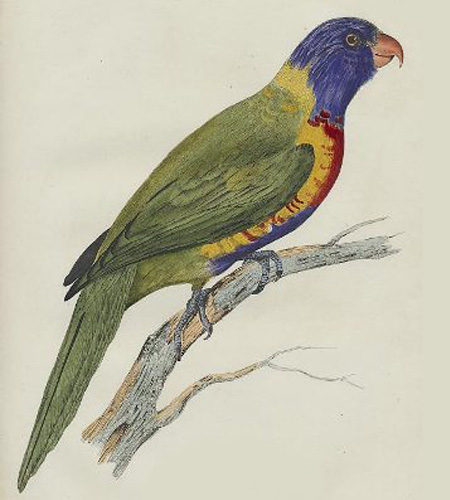
Rainbow lorikeet from Prideaux John Selby and William Jardine's Illustrations of Ornithology
Lories and lorikeets, the sub family Loriidae, are widely distributed throughout southeastern Asia, Papua New Guinea, Australia and Polynesia and are among the most colourful of all birds. They differ from other members of the parrot family in that rather than subsisting on a diet of seeds, they require pollen, nectar and fruits. As a result of their feeding habits, they play a major beneficial role in the pollination of trees and flowering plants.
Lories and lorikeets are much loved in Australia and it is difficult to imagine the Australian landscape without them. They have been described as “happy honey lovers who go shouting and screeching from district to district throughout the year, following the flow of gum blossoms”. Like most members of the family, they are highly intelligent and mischievous. The young play like puppies, rolling each other over and pretending to bite. Many of the species can also be encouraged to talk.
The rainbow or Swainson’s lorikeet is the only Australian lorikeet available to bird fanciers outside its native country.
The earliest known published illustration of an Australian parrot was of a Rainbow Lorikeet, and it appeared in Peter Brown’s “New Illustration of Zoology”, 1776. He called it the ‘Blue-Bellied Parrot’. The Rainbow Lorikeet was also the first Australian parrot to reach Britain in 1789, and this particular parrot was the special pet of a Polynesian interpreter called Tupia, who travelled back to Britain with Cook. Having survived the journey, this parrot was then given to Marmaduke Turnstall, in whose possession it was when Peter Brown painted it.

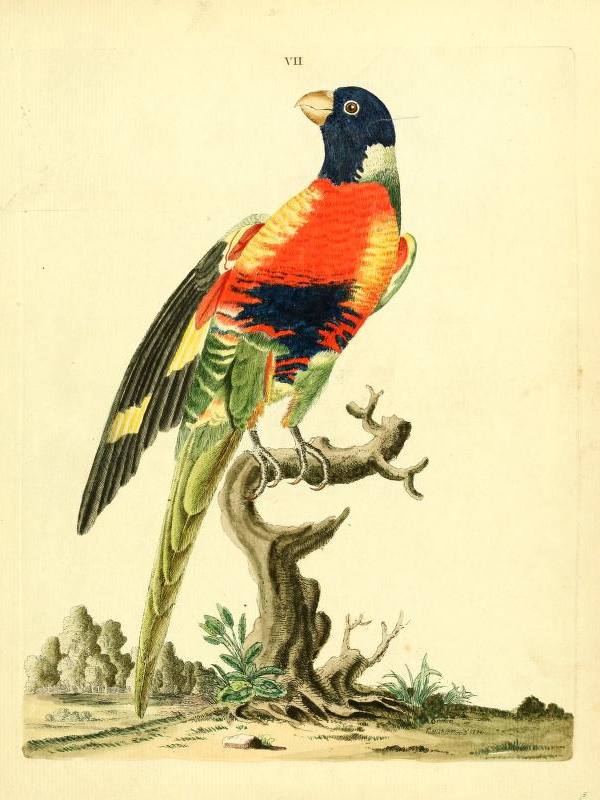
This is the earliest known published illustration of an Australian parrot, the Rainbow Lorikeet: Peter Brown’s “New Illustration of Zoology”, 1776.
| Taxonomy | |
|---|---|
| Kingdom: | Animalia |
| Phylum: | Chordata |
| Class: | Aves |
| Order: | Psittaciformes |
| Family: | Psittacidae |
| Genera: | Trichoglossus |
| Species: | haematodus |
| Sub Species: | moluccanus |
Blue-cheeked lory, Blue Mountain lory, Blue Mountain parrot, Swainson’s lorikeet, coconut lory, rainbow lory, Trichoglossus swainsonii.
Introduced bird
30 cm, 133g.
Selby, Prideaux John, and Jardine, William, Illustrations of Ornithology, published by Lizars, Edinburgh, 1826-1843.
Nouvelles illustrations de zoologie, Peter Brown, 1776.
Greene, W.T., Parrots in Captivity, 1884.
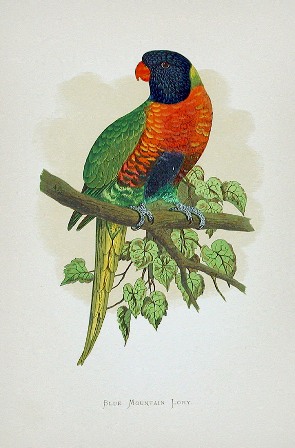
Greene, W.T., Parrots in Captivity, 1884.
Sunday, 1 October, 2023; ver2023v1