The red–necked stint, which is the smallest of our migratory waders, about the size of a sparrow, makes one of the longest migratory journeys to and from the arctic circle. There they build their nests, lay up to four eggs, protect their tiny chicks from predators and cold nights, and leave them to fend for themselves at around three weeks of age. They then fly the 11,000 and more kilometres, apparently directly to Australia, and then to New Zealand. Their offspring follow a couple of weeks later. An incredible journey for which they deserve more credit and attention than they presently get.
Around 350,000 red–necked stints visit Australia annually but only about 100–250 reach New Zealand. However, they are our fifth most numerous arctic wader.
This stint’s breeding habitat is tundra in arctic north east Siberia. It nests on the ground. They forage in wet grassland and soft mud, mainly picking up food by sight. They mostly eat insects and other small invertebrates. They are highly gregarious, and will form flocks with other waders.
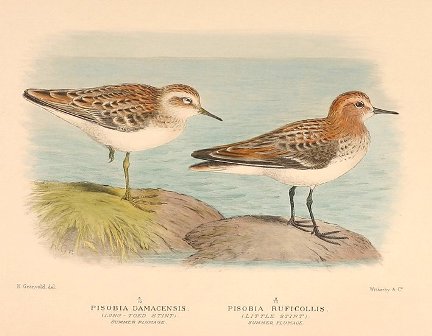
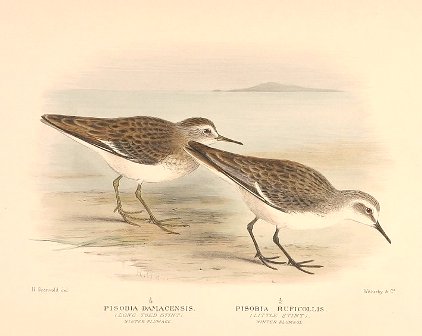
The red–necked stint is very similar to the little stint, Calidris minuta, with which they were once considered conspecific.
Other common names: —
rufous-necked stint, peep
Description: —
Native bird
15 cm., 30 g., upper parts pale grey with brown tinge, underparts white, fine dark bill, dark legs, fine bill tip, unwebbed toes and longer primary projection; breeding adult has an unstreaked orange breast, bordered with dark markings below, and a white v on its back. In winter plumage identification is difficult, although it is shorter legged and longer winged than the little stint. Juveniles have more contrasting mantle plumage and weaker white lines down the back than their relative. The call is a hoarse “stit”.
Where to find: —
Widespread in small flocks; likely to be found wintering with flocks of the endemic wrybill in areas where they are present.
Illustration description: —
Mathews, Gregory, The Birds of Australia 1910-28.
Reference(s): —
Heather, B., & Robertson, H., Field Guide to the Birds of New Zealand, 2000.
Oliver, W.R.B., New Zealand Birds, 1955.
Page date & version: —
Tuesday, 3 June 2014; ver2009v1