

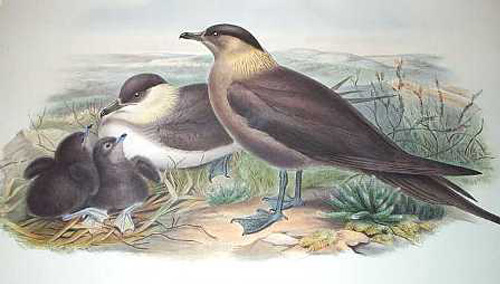
Gould, John, Birds of Great Britain, 1862–73.
T hese aggressive seabirds are sometimes referred to as avian pirates. The name is well earned. Skuas steal much of their food from terns, and other birds that are carrying fish or other prizes back to their nests and young. Skuas strike by attacking in mid-air and forcing their victims to drop their kills in flight. They sometimes team up to overwhelm their victims. They are relentless in chasing down their adversaries.
The arctic skua breeds in the northern hemisphere, on open spaces inland, on coastal flats and islands, from the Arctic circle to as far south as northern Scotland. Each pair occupies its own territory on moorland, tundra or shingle and in an unlined shallow scoop the female lays two eggs. The breeding birds eat a range of food from small mammals and insects to other birds, their eggs and young.
In North America, arctic skuas are known as parasitic jaegers, a name which is derived from the German "hunter."
The arctic skua migrates south around September and passes through the tropics to winter in the southern hemisphere. They are common in New Zealand waters from November — April and, during that time, are the most numerous skua seen off the coasts of the mainland and the Chatham Islands. They sometimes join roosting flocks of terns or gulls. It is usual to see them harrying white–fronted terns or small gulls which they may force to drop or regurgitate fish.
Both light- and dark-colored morphs of this bird occur, though scientists are not yet sure what natural advantages each color affords.

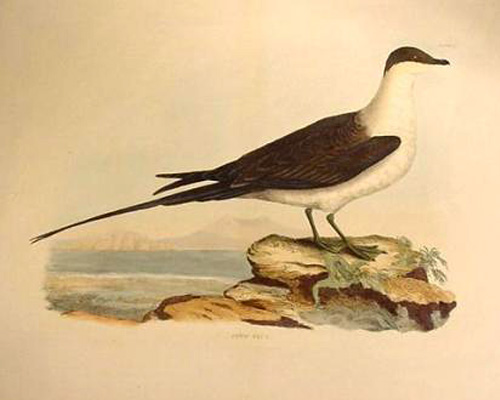
Selby, Prideaux J., Illustrations of British Ornithology, 1824–34.
| Taxonomy | |
|---|---|
| Kingdom: | Animalia |
| Phylum: | Chordata |
| Class: | Aves |
| Order: | Charadriiformes |
| Family: | Stercorariidae |
| Genera: | Stercorarius |
| Species: | parasiticus |
| Sub Species: |
Parasitic jaegar
Arctic migrant
43 cm., excluding central tail feathers, dark phase and light phase, bill black, feet and legs black.
They are common in New Zealand waters from November - April and, during that time, are the most numerous skua seen off the coasts of the mainland and the Chatham Islands.
Gould, John, Birds of Great Britain, 1862–73.
Selby, Prideaux J., Illustrations of British Ornithology, 1824–34.
Heather, B., & Robertson, H., Field Guide to the Birds of New Zealand, 2000.
E.C. Young, Emeritus Professor of Zoology, Auckland University. [email protected]
Monday, 14 August, 2023; ver2023v1