Sulphur–crested cockatoos arrived in New Zealand as caged birds from Australia. Since about 1920 some have escaped and others have been released. Possibly this feral population is occasionally boosted with wind–blown stragglers from Australia. Such a bird may have arrived in May 1959 when after three days of strong westerlies a sulphur–crested cockatoo was seen at the southern head of Kaipara Harbour, so tired it would fly only downwind. In New Zealand the species’ largest colonies are in the watersheds of the Turakina and Rangitikei Rivers near Wanganui, where a population of about 400 birds was estimated in 1962, and also between the lower Waikato and Raglan Rivers where a flock of about 200 birds was seen in 1964.
Little is known about its breeding habits in New Zealand. At Hunterville in January birds were seen entering and leaving a nest hole high up in a kahikatea tree. Presumably the cockatoos were incubating eggs or else brooding young nestlings. Another nest was found on top of a pile of hay bales under the roof of a barn. In Australia, the nest is usually in a hollow limb or hole high up in a large tree. It also nests in cliff holes. On a layer of decayed wood–dust lining the bottom of the hole, the female lays two or three white, elliptical eggs. Both sexes incubate the eggs which hatch after about 30 days. The nestlings leave the nest at about 40 days old.
When giving his courtship display, the male struts along a branch towards the female. With crest raised he bobs and sways his head in a figure–of–eight movement, calling soft, chattering notes. Mutual preening and bill–touching follow.
The Sulphur–crested Cockatoo’s normal diet consists of berries, seeds, nuts and roots. It also takes handouts from humans. The species has become a pest around urban areas, where it uses its powerful bill to destroy timber decking and panelling on houses. Feeding normally takes place in small to large groups, with one or more members of the group watching for danger from a nearby perch.
Other common names: —
Description: —
Introduced bird
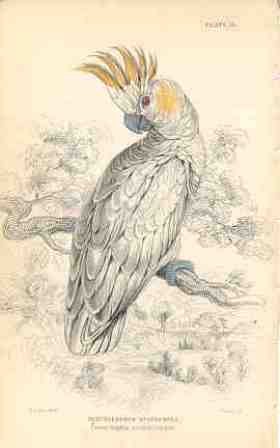
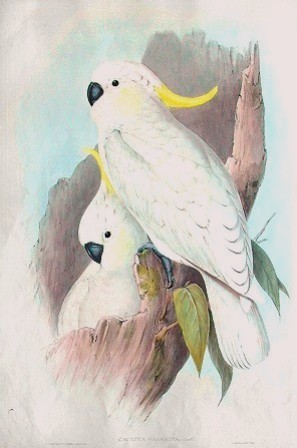
50 cm., 900 g., white parrot, dark grey-black bill,distinctive sulphur-yellow crest and a yellow wash on the underside of the wings. Sexes are similar, although the female can be separated at close range by its red-brown eye (darker brown in the male).
Where to find: —
Turakina and Rangitikei Rivers near Wanganui, lower Waikato and Raglan Rivers.
Poetry: —
Now the autumn maize is growing,
Now the corn-cob fills,
Where the Little River flowing
Winds among the hills.
Over mountain peaks outlying
Clear against the blue
Comes a scout in silence flying,
One white cockatoo.
Back he goes to where the meeting
Waits among the trees.
Says, “The corn is fit for eating;
Hurry, if you please.”
Skirmishers, their line extendiing,
Shout the joyful news;
Down they drop like snow descending,
Clouds of cockatoos.
At their husking competition
Hear them screech and yell.
On a gum tree’s high position
Sits a sentinel.
Soon the boss goes boundary riding;
But the wise old bird,
Mute among the branches hiding,
Never says a word.
Then you hear the strident squalling:
“Here’s the boss’s son,
Through the garden bushes crawling,
Crawling with a gun.
May the shiny cactus bristles
Fill his soul with woe;
May his knees get full of thistles.
Brothers, let us go.”
Old Black Harry sees them going,
Sketches Nature’s plan:
“That one cocky too much knowing,
All same Chinaman.
One eye shut and one eye winkin’ —
Never shut the two;
Chinaman go dead, me thinkin’,
Jump up cockatoo.”
— A B Banjo Paterson
Illustration description: —
Jardine, Sir William, Naturalist’s Library, 1836.
Gould, John, Birds of Australia, 1840–48.
Reference(s): —
Heather, B., & Robertson, H., Field Guide to the Birds of New Zealand, 2000.
Oliver, W.R.B., New Zealand Birds, 1955.
Page date & version: —
Thursday, 5 June 2014; ver2009v1