

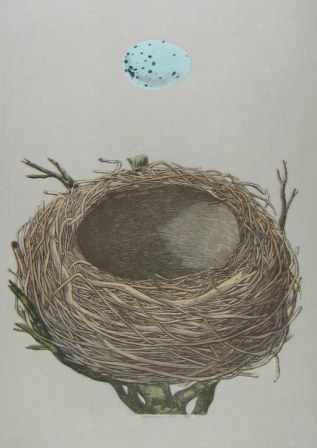
Morris, Reverend F.O., A Natural History of the Nests and Eggs of British Birds, 1863.
Males establish territories from April but often the same territory is used by the same pair year after year. They defend their territories for about nine months. The territorial song of the male is usually delivered from a high point. The mornings and evenings are favoured for singing.
The thrush places its nest in a tree or shrub usually only a few feet from the ground. The nest is built of grass and sticks and lined with a plaster of decayed wood and grass cemented with saliva. This is often described as mud, says Oliver, but earth is only occasionally included. Pairs will replace lost nests and they may nest 2-5 times each year and raise several broods, usually in different nests. The female builds the nest in one to two weeks.
A clutch of four to five eggs is laid from early August to late December but occasionally from as early as May until February. The eggs are bluish green with scattered black or purplish spots chiefly at the larger end. Incubation takes from 12-13 days.
Both parents feed the nestlings which fledge at 13-15 days. The young birds remain with the parents and are occasionally fed several weeks after being fledged.
The thrush feeds on insects, snails, worms, slugs, and soft fruits. The thrush is conspicuous with its habit of using an anvil to break the shells of snails. Small heaps of broken shells may be found near a favoured anvil.
The thrush is seldom found in native forest, prefering suburban gardens.
The thrush was among the earliest birds introduced to New Zealand, the first to be landed were five birds introduced to Nelson in 1862.
— Narena Olliver, July, 2007

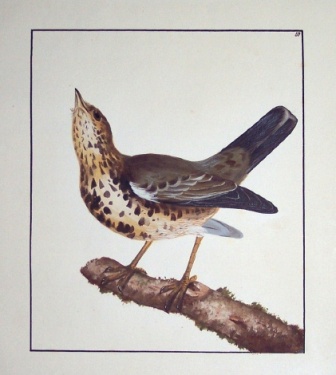
Lewin, William, Birds of Great Britain, 1789.
| Taxonomy | |
|---|---|
| Kingdom: | Animalia |
| Phylum: | Chordata |
| Class: | Aves |
| Order: | Passeriformes |
| Family: | Muscicapidae |
| Genera: | Turdus |
| Species: | philomelos |
| Sub Species: |
mavis, throstle
Introduced bird
23 cm., 70 g., sexes alike, brown above, buff white underparts, spotted dark brown, yellowish bill, legs pinkish, juvenile rusty brown.
Widespread and common.
Song Thrush
LINK to Song Thrush MAIN Page
Poetry: —
The Thrush's Nest
Within a thick and spreading hawthorn bush,
That overhung a molehill large and round,
I heard from morn to morn a merry thrush
Sing hymns to sunrise, and I drank the sound
With joy; and, often an intruding guest,
I watched her secret toils from day to day--
How true she warped the moss, to form a nest,
And modelled it within with wood and clay;
And by and by, like heath-bells gilt with dew,
There lay her shining eggs, as bright as flowers,
Ink-spotted-over shells of greeny blue;
And there I witnessed in the sunny hours
A brood of nature's minstrels chirp and fly,
Glad as that sunshine and the laughing sky.
— John Clare
Morris, Reverend F.O., A Natural History of the Nests and Eggs of British Birds, 1863.
Lewin, William, Birds of Great Britain, 1789.
Heather, B., & Robertson, H., Field Guide to the Birds of New Zealand, 2000.
Oliver, W.R.B., New Zealand Birds, 1955.
Sunday, 3 September, 2023; ver2023v1