There are two sub–species of turnstone, the nominate interpres which breeds throughout the arctic and migrates to tropical and temperate coasts of both hemispheres, and morinella which breeds in subarctic North America and migrates to South America and Pacific islands. Both visit New Zealand. Turnstones are the third most numerous of the arctic waders to visit New Zealand.
Turnstones breed in the Arctic tundra. Nests are located on the open ground in wet tundra areas or dry rocky ridges. They are sometimes well concealed among rocks or under shrubs. The female builds the nest, a shallow depression with a sparse lining of leaves. Both parents incubate the four eggs for 22 to 24 days. The young leave the nest shortly after hatching and follow the male to food. They feed themselves, but both parents help protect and tend the young. The female usually departs first, leaving the male to watch over the young until they can fly, typically at 19 to 21 days.
The name derives from its method of looking for its food of insects and shellfish which it finds by turning over stones, shells, seaweed, using its bill.
Other common names: —
ruddy turnstone
Description: —
Migratory Wader
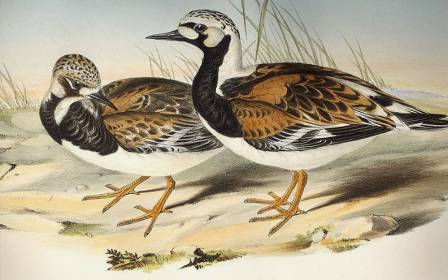
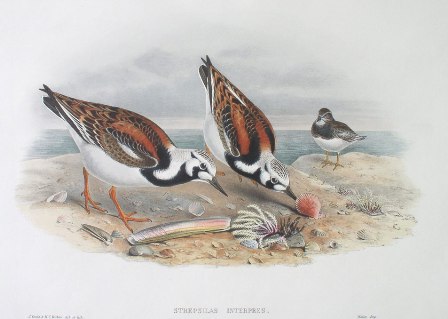
23 cm., 120 g., colourful wader with varigated white, black, brown and tortoise-shell plumage, black bill, short orange legs; non breeding plumage predominantly dark brown with white underparts.
Where to find: —
They concentrate in certain favoured localities, Parengarenga, Rangaunu, Kaipara, Manukau and Tauranga Harbours and the Firth of Thames in the North Island; Farewell Spit, Motueka Estuary, Lake Grassmere, Kaikoura peninsular and the coastal lagoons and estuaries of Southland in the South Island.
Poetry: —
Death of the Bird
For every bird there is this last migration;
Once more the cooling year kindles her heart;
With a warm passage to the summer station
Love pricks the course in lights across the chart.
Year after year a speck on the map divided
By a whole hemisphere, summons her to come;
Season after season, sure and safely guided,
Going away she is also coming home;
And being home, memory becomes a passion
With which she feeds her brood and straws her nest;
Aware of ghosts that haunt the heart's possession
And exiled love mourning within the breast.
The sands are green with a mirage of valleys;
The palm-tree casts a shadow not its own;
Down the long architrave of temple or palace
Blows a cool air from moorland scraps of stone.
And day by day the whisper of love grows stronger,
The delicate voice, more urgent with despair,
Custom and fear constraining her no longer,
Drives her at last on the waste leagues of air.
A vanishing speck in those inane dominions,
Single and frail, uncertain of her place.
Alone in the bright host of her companions,
Lost in the blue unfriendliness of space.
She feels it close now, the appointed season:
The invisible thread is broken as she flies;
Suddenly, without warning, without reason,
The guiding spark of instinct winks and dies.
Try as she will the trackless world delivers
No way, the wilderness of light no sign,
The immense and complex map of hills and rivers
Mocks her small wisdom with its vast design.
And darkness rises from the eastern valleys,
And the winds buffet her with their hungry breath,
And the great earth, with neither grief not malice,
Receives the tiny burden of her death.
— A.D. Hope
Illustration description: —
Gould, John, Birds of Australia, 1840–48.
Gould, John, Birds of Great Britain, 1862–73.
Reference(s): —
Heather, B., & Robertson, H., Field Guide to the Birds of New Zealand, 2000.
Oliver, W.R.B., New Zealand Birds, 1955.
Page date & version: —
Thursday, 5 June 2014; ver2009v1