

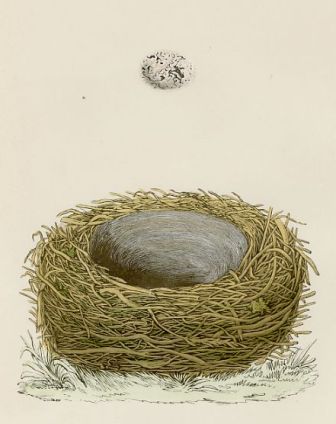
Yellowhammer nest from Reverend F.O. Morris' A Natural History of the Nests and Eggs of British Birds, 1863.
Males start singing in their territories in late August. The call of the yellowhammer, to my mind, sounds a bit like the opening bars of Beethoven’s fifth symphony, although somewhat dull and repetitive and no where near as inspired. An old Scottish friend of mine has described it as having the rythmn of ‘a–little–bit–of–bread–and–no–cheese’ which requires more than a little imagination to make the words fit the song.
Finding the yellowhammer’s nest is a real challenge. It is usually built very close to the ground in gorse, blackberry, bracken or long grass. It is roughly constructed of grass and small sticks and lined with finer grass, hair, moss wool and feathers.
Between October and mid-February, the yellowhammer may lay up to five whitish–pink eggs covered in fine scribbling brown lines. The female does most of the incubation, the eggs hatching in 12-14 days.
Both parents feed the young and the young birds fledge in about 13 days.
Diet is a mix of insects and seeds from a variety of introduced weeds, grasses clover and cereals.

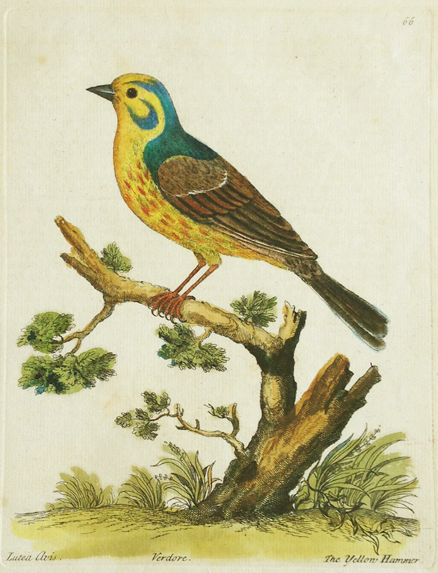
Yellowhammer from Eleazar ALBIN's The Natural History of Birds, 1735-50.
| Taxonomy | |
|---|---|
| Kingdom: | Animalia |
| Phylum: | Chordata |
| Class: | Aves |
| Order: | Passeriformes |
| Family: | Emberizidae |
| Genera: | Emberiza |
| Species: | citrinella |
| Sub Species: |
Yellow bunting, yellow yowley, yellow yeldrin, yellow yoldrin, yellow yite, yeldrock, yolkring, yoit, skite, goldie, yellow amber, yellow ring, scribble lark, scribbler.
Introduced bird
16 cm., 27 g., yellow bird with reddish brown upperparts, streaked with darker brown; this distinguishes it from the cirl bunting which has a greenish rump; male has bright yellow head and underparts, the female is more heavily marked with brown streaks., the juvenile is similar to the female.
Widespread and common.
Yellowhammer
LINK to the Yellowhammer MAIN Page
Poetry: —
When shall I see the white thorn leaves agen
And yellowhammers gath'ring the dry bents
By the dyke side on stilly moor or fen
Feathered wi love and natures good intents
Rude is the nest this Architect invents
Rural the place wi cart ruts by dyke side
Dead grass, horse hair and downy headed bents
Tied to dead thistles she doth well provide
Close to a hill o' ants where cowslips bloom
And shed o'er meadows far their sweet perfume
In early Spring when winds blow chilly cold
The yellowhammer trailing grass will come
To fix a place and choose an early home
With yellow breast and head of solid gold.
— John Clare
Morris, Reverend F.O., A Natural History of the Nests and Eggs of British Birds, 1863.
Eleazar Albin, The Natural History of Birds, (1731-38).
Heather, B., & Robertson, H., Field Guide to the Birds of New Zealand, 2000.
Oliver, W.R.B., New Zealand Birds, 1955.
Tuesday, 5 September, 2023; ver2023v1