

It is a Sunday morning at Ohiwa Spit. We are there for the winter wader count for the Ornithological Society. It is one of those lovely, fine, calm winter days when, as one of my companions says, one has to thank the universe, God, or whatever, for just being alive.
It is approaching high tide and the birds are still flying in to roost on the sand spit. As the tide encroaches on their feeding grounds, the birds look for a place to roost until the tide moves out again. It is these habitual roosting sites which give us the opportunity to count the birds with some accuracy and reliability.
In view of the increased impacts of human influences on wader habitats the Ornithological Society of New Zealand initiated the National Wader Count scheme in 1983. The aims of the study are to determine firstly the numbers and distribution of waders occurring at coastal sites throughout New Zealand; secondly, the seasonal changes in the distribution and numbers of waders; and thirdly, the annual changes in the numbers of waders. Migratory shorebirds of many species are in decline. Habitat loss and other changes to their wintering wetland habitats around the world are affecting these birds. Of more recent concern is the impact of climate change on the numbers of migratory birds, especially that iconic bird to New Zealanders, the bar-tailed godwit.
Between 85,000 to over 100,000 bar–tailed godwits visit New Zealand annually. From 8,000 to 18,000 birds, roughly ten percent of the population, remain to winter over in New Zealand, presumably mainly juveniles as few are in breeding plumage. It is these birds that we are counting as they rest on the sand spit with other waders, South Island pied oystercatchers, variable oystercatchers, New Zealand and banded dotterels, and Caspian and white-fronted terns, not to speak of gulls. The godwit’s extraordinary long upturned bill distinguises and characterises an otherwise rather plain unassuming bird, considering its legendary reputation.
Populations of the godwit embark on some of the longest migrations known among birds. They start arriving here in New Zealand about mid–September and disperse throughout the country including the Chatham Islands. They flock in a few favoured places, including the Firth of Thames and Ohiwa Harbour. They leave New Zealand in March and early April and arrive in the northern hemisphere in May and early June. The baueri race breeds in western Alaska and spends the nonbreeding season in New Zealand and eastern Australia; the menzbieri race breeds in Siberia and migrates to western and northern Australia. Although the menzbieri race are known to follow the coast of Asia during both migrations, the southern pathway followed by the baueri race remained unknown until quite recently.
A team of scientists, including New Zealand scientists, headed by Robert Gill Jr. of the U.S. Geological Survey Alaska Science Center in Anchorage, have recently unlocked the secret of the extraordinary migration of the New Zealand sub species of the bar–tailed godwit.
Beringia is where the godwits begin their journey. This outcrop of land where Asia and America nearly touch is a global cross roads, a springboard for millions of migratory birds of a variety of species. Just to name a few mingling with the bar–tailed godwits bound for New Zealand, are Hudsonian godwits aiming for Tierra del Fuego; Arctic warblers which migrate to the Philippines; Wilson’s warblers which fly to Central America; fox sparrows and golden-crowned sparrows that winter in Pacific coastal woodlands, and gray-cheeked thrushes that travel to the Amazon; northern wheatears traveling across Asia for wintering grounds in Africa, and Swainson’s thrushes moving south to the equatorial forests of Venezuela and Brazil. Approximately one-quarter of the world’s shorebirds breed in tundra and boreal habitats of the arctic and sub-arctic. These habitats provide well-camouflaged nesting sites for these ground-nesting species, and the abundance of invertebrates following snow-melt provides the conditions for rapid chick growth during a very short season.
A team of researchers headed by Robert Gill Jr. of the U.S. Geological Survey Alaska Science Center in Anchorage implanted tiny satellite trackers in female godwits near the Alaska coast. Prior to their southward migration, the godwits eat up large, until up to 55 per cent of their body weight is fat. They then reduce the size of their gut, kidney and liver by up to 25 per cent to compensate for the added weight. The scientists think that the birds reshuffle proteins in their bodies before they set out and that this allows them to reduce the size of their food-processing organs. Stuffed with fuel, the godwits are ready for the air. Assessing the weather patterns in Alaska, the team found that the godwits timed their departures to coincide with favorable tail winds that helped them fly south. “All birds took off with favorable winds,” says Gill, who added that tail winds caught in Alaska can shoot these birds 3,000 to 5,000 kilometers. “Some birds get shot almost to Hawaii,” says Gill. Scientists don’t know how the godwits assess weather patterns or navigate. What’s more, the satellite trackers can’t measure altitudes — the birds could be skimming the ocean or flying thousands of feet above the surface, says Gill. A female bar–tailed godwit, implanted with a tiny satellite tracker, lifted off from her Alaskan breeding ground and flew south 11,680 kilometers, nonstop, until she reached her winter home in New Zealand. Called E7 by the scientists who monitored her, she flew more than eight days without food, water or rest, on the longest direct flight by a bird ever documented.
Just what drives these extraordinary migrations? Obviously feeding and breeding opportunities. What climate changes in the deep past provoked these great migrations? Did the birds adapt slowly over long periods of time, or did they have to make sudden adjustments? Changes in weather and climate would have affected the food supplies that drove these migrations in the past. What will climate change do in the future to these birds? Will they be able to adjust? Will the number of birds choosing not to make the long haul north to Alaska increase? Will they decide to breed in New Zealand? Gill and his colleagues think that the birds may have taken the Asian route eons ago, but birds that shaved thousands of miles by flying direct may have been the fittest ones that passed on their genes.
The earth’s climate has been changing throughout time. Some bird species were able to adapt to these changes, while others became extinct as a result. This is a natural process. However, the climate change we are experiencing today is different, human-induced global warming is happening at a faster rate and it is becoming increasingly difficult for many bird species to adapt to the fast increasing shifts in weather patterns. Highly sensitive to climate and weather, birds are pioneer indicators of climate change, the proverbial “canaries in the coal mine.“ Birds from the Arctic to Antarctic are already responding to these changes, but how well will they be able to respond to predicted sea level rises, fire hazards, vegetation changes and land use change. With a doubling of atmospheric CO2, climate change could eventually destroy or fundamentally alter 35 per cent of the world’s existing land habitats. In the Arctic, where several hundred million migratory birds breed, a doubling of CO2 suggests the loss of almost half the breeding grounds of 10.4 million geese and 14.5 million waders by 2080-2099. Some Arctic birds will lose more than 90 per cent of their habitat at higher levels of warming. These new weather-related threats are potentially serious for species already pushed to their physiological limit by their migratory journey, such as the bar-tailed godwit; this according to the report to the Worldwide Fund for Nature, Bird Species and Climate Change, the Global Report.
However, the future of Kuaka, the bar-tailed godwit, depends very much on our own future, the future of Homo sapiens sapiens, and the ability of our species to adapt or even survive climate change. The reality is that with fewer people around, more species, including the bar-tailed godwit, may come through these changes.
Other common names: —
Description: —
Native bird
Male, 39 cm., bill 85 mm., 300 g., female, 41 cm., bill 105 mm., 350 g., nondescript long billed wader, breeding plumage red, bill slightly upturned, legs and feet black.
Where to find: —
Found on estuaries thoughout New Zealand.
Youtube video —
Poetry: —
What are you doing, all flocked on Reinga?
What is your hurry - the trees are all gold?
Sweeting, we gather because we must leave you.
April is cold; April is cold!
Oh! We shall miss you, my little kuaka;
Where will you go then, my wild little one?
Over the sea to the country of Russia,
Into the sun; into the sun.
We'll nest on the steppes and put on our red kirtles.
Teaching our scared little children to fly.
Then we stretch wing for the sea and the summer,
Forth in July; forth in July.
Where will you be in the windy September?
Little kuaka, where will you be?
In China, the land of the iris and poppy,
On a white tree; on a white tree.
Will you forget us, or will you remember?
I shall remember, wherever I roam.
Look for me, sweet, on the first of December
I shall come home; I shall come home.
— Eileen Duggan
Illustration description: —
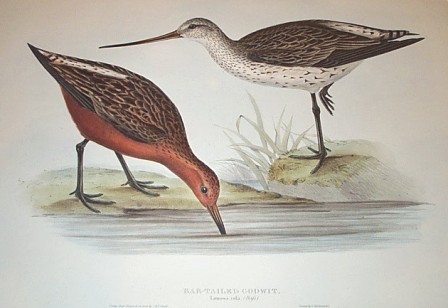
Gould, John, Birds of Europe, 1832-37.
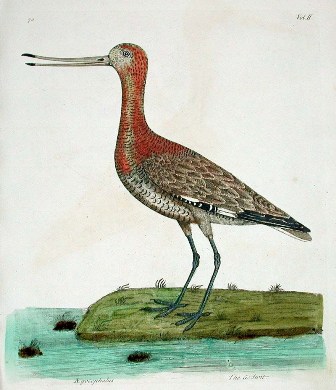
Albin, Eleazar, Natural History of Birds, 1731-38.
Reference(s): —
Heather, B., & Robertson, H., Field Guide to the Birds of New Zealand, 2000.
Page date & version: —
Monday, 26 May 2014; ver2009v1