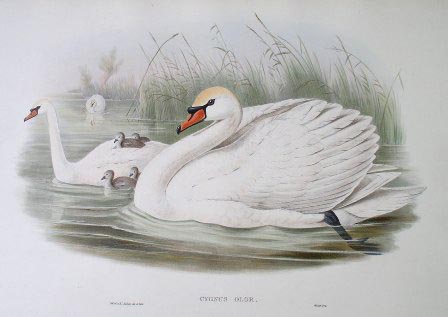
The mute swan is one of seven swan species found world–wide and was introduced to New Zealand from 1866. It maintains a tenuous hold in the wild on wetlands in Hawke’s Bay, North Canterbury and lake Ellesmere. Some live in a semi–feral state in town parks. They once numbered several hundred in the wild but the April 1968 Wahine storm destroyed much of their feeding habitat in their stronghold at Lake Ellesemere and the popluation crashed. There are now perhaps only 100 in the wild.
In New Zealand it is a protected introduced species. Its natural range is northern Eurasia from Great Britain to eastern Russia.
Two mute swans, a male (cob) and female (pen), were purchased from Ducks Unlimited a few years ago by residents of Sullivan Lake in Whakatane, in the Bay of Plenty. The cob died, together with numerous ducks, during a run of botulism. The pen was taken back to Ducks Unlimited and found a new partner and they were both returned to the lake. So, the saying that swans mate for life and pine to death from losing a mate is not always true.
Due to the frequent outbreaks of botulism with ducks and other wildlife, Whakatane District Council decided to keep the lake clean by flushing it with fresh water when needed.
In spring last year (2001), the pen laid 6 eggs (up to 11 can be laid) on a small island on the lake. She sat for well over the 35 days it takes for hatching and then deserted the nest. Two of the eggs disappeared, and we are not sure whether it was people or a predator that took them. Had the eggs hatched both parents would have looked after them. The female does all the incubating of eggs with the male guarding her. At this time he can be very aggressive. They are very large and powerful birds. When the males have territorial fights they can be quite terrifying as each tries to seize the others head and hold it under water.
The cygnets are covered in a grey down when they first hatch, they are escorted round the lakes by their parents. The down then changes to a brownish white plumage, this then changes over the year to the white feathers of the adult swan. The birds fledge at between 120–150 days. The parents may then chase off the young, as they become adults. Breeding starts at three to four years of age.
Aquatic plants make up a lot of the swan’s diet, but they will graze on grass and clover, as well as taking leaves from overhanging willow. Supplementary feeding may be needed when there is a lack of aquatic weeds. Maize, wheat and a small amount of bread may be given, but care must be taken to ensure that the grains and bread are not mouldly.
The lifespan of the swan can be up to 25 years, but in the wild some only survive for five or six years. Some of the reasons for this can be collisions with powerlines, attacks by dogs, lead poison from digesting fishing weights, lead shot from ducks that have died and rotted in lakes after being shot, and botulism.
For many centuries, mute swans in Britain were domesticated for food, with individuals being marked by nicks on their webs or beak to indicate ownership. These marks were registered with the Crown and a Royal Swanherd was appointed. Any birds not so marked became Crown property, hence the swan becoming known as the Royal Bird. It is quite possible that this domestication saved the swan for being hunted to extinction in Britain.
Swans are no longer kept for food, but in England the Crown still has an official Swan Keeper and the ancient ceremony of swan-upping, when swans on the Thames are rounded up for identification by the Crown, still takes place on the Monday of the third week in July. As well as being a source of food other parts of the bird were used; feathers as quills for writing; the leathery web for making purses and wing bones for making whistles. Old records show that the menu for an important medieval banquet might include as many as fifty swans.
They have a very large place in European mythology and folklore.
Other common names: —
Description: —
Introduced bird
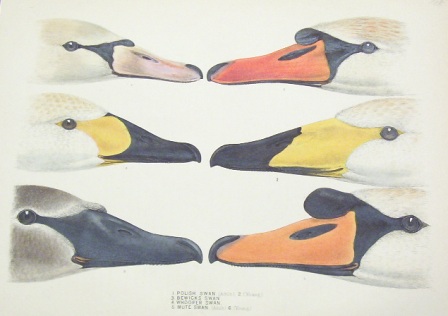
150 cm., males 12 kg., females 10 kg., white, bill orange with black knob at base.
Where to find: —
Hawkes Bay, North Canterbury wetlands, Lake Ellesmere, also town parks.
Poetry: —
The Wild Swans at Coole
The trees are in their autumn beauty,
The woodland paths are dry,
Under the October twilight the water
Mirrors a still sky;
Upon the brimming water among the stones
Are nine and fifty swans.
The nineteenth autumn has come upon me
Since I first made my count;
I saw, before I had well finished,
All suddenly mount
And scatter wheeling in great broken rings
Upon their clamorous wings.
I have looked upon those brilliant creatures,
And now my heart is sore.
All’s changed since I, hearing at twilight,
The first time on this shore,
The bell–beat of their wings above my head,
Trod with a lighter tread.
Unwearied still, lover by lover,
They paddle in the cold,
Companionable streams or climb the air;
Their hearts have not grown old;
Passion or conquest, wander where they will,
Attend upon them still.
But now they drift on the still water
Mysterious, beautiful;
Among what rushes will they build,
By what lake’s edge or pool
Delight men’s eyes, when I awake some day
To find they have flown away?
— William Butler Yeats
Leda and the Swan
A sudden blow: the great wings beating still
Above the staggering girl, her thighs caressed
By the dark webs, her nape caught in his bill,
He holds her helpless breast upon his breast.
How can those terrified vague fingers push
The feathered glory from her loosening thighs?
And how can body, laid in that white rush,
But feel the strange heart beating where it lies?
A shudder in the loins engenders there
The broken wall, the burning roof and tower
And Agamemnon dead.
Being so caught up,
So mastered by the brute blood of the air,
Did she put on his knowledge with his power
Before the indifferent beak could let her drop?
— William Butler Yeats
Credit for the photograph: —
Illustration description: —
Gould, John, Birds of Great Britain, 1862–73.
Dresser, Henry E., Birds of Europe, 1871–1896.
Reference(s): —
Heather, B., & Robertson, H., Field Guide to the Birds of New Zealand, 2000.
Oliver, W.R.B., New Zealand Birds, 1955.
Page date & version: —
Wednesday, 28 May 2014; ver2009v1