
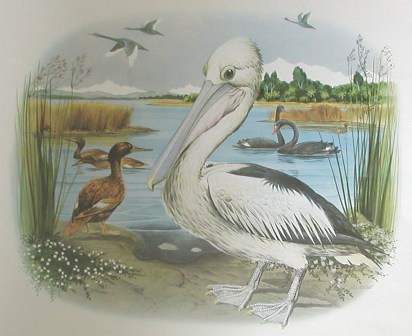
Subfossil bones of the New Zealand pelican have been found at Lake Grassmere in Marlborough and at four North Island sites: Karikari Penisula, Motutapu Island, Lake Waikaremoana and Lake Poukawa. The pelvis is broader and more robust than the modern Australian pelican and so is regarded as a distinct species. The skeleton found at Poukawa is 3,500 – 4,500 years old. Bones from other sites are younger and may post–date man’s arrival in New Zealand. This species may have weighed as much as 12 kgs; the heaviest flying bird today is the trumpeter swan, Cygnus cygnus, which weighs about 12.5 kgs.
However, Worthy and Holdaway do not think New Zealand had a resident breeding population of pelican on the basis that its occurence in the fossil record is not significant and have returned the New Zealand pelican to the Australian P. conspiculatus.
Other common names: —
Description: —
Extinct bird
12 kgs.
Illustration description: —
A. Mitchell
Reference(s): —
Oliver, W.R.B. New Zealand Birds, 1955.
Gill & Martinson, NZ Extinct Birds, 1991.
Worthy, Trevor H., & Holdaway, Richard N., The Lost World of the Moa, 2002.
Page date & version: —
Thursday, 22 August 2019; ver2009v1