
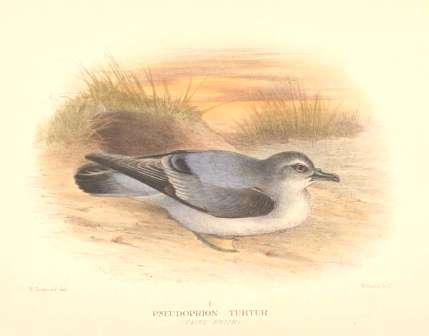
The Fairy Prion is found throughout oceans and coastal areas in the Southern Hemisphere. Their colonies can be found on islands around New Zealand, the Bass Strait Islands of Australia, the Crozet Islands in the south Indian Ocean and the Falkland Islands and South Georgia in the south Atlantic.
Fairy prions are among New Zealand’s most abundant petrels, and are seen in offshore waters from North Cape to Foveaux Strait and breeding on islands from the Poor Knights to the Antipodes Islands.
The largest breeding colony of fairy prions is on Stephens Island in Cook Strait where tuatara account for the loss of up to 25 per cent of the eggs. Breeding begins in September, and they incubate their egg for about 55 days. After the chick hatches, they feed it for 43 to 56 days, and then all the birds fly to subtropical waters off the coasts of Australia and South Africa. Skuas are their main predators.
Fairy prions have been recently reintroduced to Mana Island off the coast of Wellington as part of a larger restoration programme for the island, which to date has also seen the introduction of takahe, North Island robin, brown teal, diving petrels, yellow-crowned kakariki, speckled and spotted skinks, Wellington green geckos and flax weevils. A wetland has been restored and hundreds of thousands of native trees have been planted by volunteers. Fairy prion and other burrowing seabirds are “keystone” species for island ecosystems. Their burrows create safe, sheltered and humid homes for lizards, tuatara and insects. Because they feed at sea and nest in dense colonies, they create highly fertile ecosystems by delivering nutrients in the form of droppings, spilt regurgitations, addled eggs and corpses. A similar programme to transfer chicks of diving petrels to Mana Island during 1997–99 was also successful.
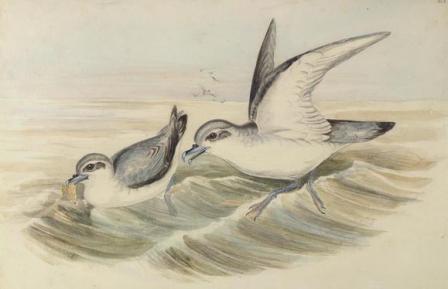
This is the smallest prion and has a narrow pincer-like bill. Fairy prions eat krill and other small crustaceans, which they either peck while sitting on the water or take while in flight, making only momentary contact with the water.
The prions are small petrels and together with the blue petrel, they form one of the four groups within the Procellariidae (also referred to as the prions), along with the gadfly petrels, shearwaters and fulmarine petrels.
Birdlife fact sheet estimates the global population of Fairy prions in 2004 to be around 5,000,000 individuals.
— Greytown, 2011
Other common names: —
narrow-billed prion
Description: —
Native bird
25 cm., 125 g., sexes alike, blue-grey head and back, a white throat and belly, a black M-shaped mark across their wings, and a broad black tip to their tail, blue bill, legs blue.
Where to find: —
Abundant off the coast near breeding colonies, Poor Knights, Cook Strait, Foveaux Strait and Snares Islands.
Illustration description: —
Mathews, Gregory, The Birds of Australia 1910-28.
Gould, John, Birds of Australia, 1840-48.
Reference(s): —
Heather, B., & Robertson, H., Field Guide to the Birds of New Zealand, 2000.
Readers Digest Complete Book of NZ Birds, 1985.
Olliver, W.R.B., New Zealand Birds, 1955.
Page date & version: —
Monday, 2 June 2014; ver2009v1