
I used to see rooks in the northern Wairarapa on my sister’s farm under the Ruahine mountain range not far from Ekatahuna. There, the open rolling landscape, shaped by dairy farms with shelter belts of old macrocarpa trees (Monterey cypress) and Lombardy poplars, attracts few birds other than the more common introduced birds, and many magpies. The eastern rosella, which is there in quite large numbers, is the brightest spot in an otherwise dull avian landscape. Now sadly the Regional Council is intent upon exterminating rooks, and for no good reason as far as I can see.
The rook is a black, hoarse–voiced bird about the size of a magpie which was brought to New Zealand from Britain between 1862 and 1874 to help control insects and to remind settlers of home. Unlike many other European birds introduced at the same time, rooks have spread very slowly. Even as late as 1970, they were largely confined to parts of the Hawke’s Bay, Manawatu, southern Wairarapa and Canterbury.In the 1971 rooks were declared an agricultural pest in the Hawke’s Bay and something like 35,000 thousand were shot, probably about half the population. Displaced rooks then spread more rapidly and established colonies near Miranda, Tolaga Bay near Gisborne and southern Waikato among other places including Northland.
The rooks belong to the family Corvidae which includes crows and jays and are among the more intelligent birds. Their natural breeding range is Europe and Asia, east Siberia and Mongolia. Many migrate south to winter around the Mediterranean, in Iran and the northern part of the Indian sub continent.
Rooks like areas where there are walnut trees and agricultural crops, especially cereals. They avoid the bush and forested areas so are no real threat to our native or endemic birds. The habit of storing walnuts is of special interest. Ripening nuts are picked from a tree and carried some distance and buried intact in open paddocks, in a tuft of grass or between clods of ploughed soil. The birds return in autumn to recover the stored nuts, which they hold on the ground with one foot while hammering a hole through the hard shell to extract the kernel.
The social organization of these remarkable birds is very complex. Rooks are gregarious, not only when feeding together but also breeding and roosting together.
In late August, nests are built in the tops of very tall trees such as poplars and pines. Several nests may be within a few metres of each other and large rookeries may contain several hundred nests. The nest is large and untidy and is made of twigs, leaves and mud and lined with grass. The female incubates the bluish green eggs blotched with brown and is fed by the male while brooding.
During winter, up to 5000 or more birds from several breeding rookeries will travel up to 20 kilometres each night to roost together at a large or long established rookery, called “parishes”. In the morning they disperse to feeding grounds around their own rookeries.
Note:(October 2010)Greater Wellington Regional Council is once again asking people to report on rookeries in the area. This pursuit of rooks brings into question Regional Council's pest strategies especially in relation to birds.
Rooks are a minor agricultural pest, certainly no worse than say yellowhammers, so why is one being pursued and not the other? It would seem that one of requirements of the Biosecurity Act is that pest control must be cost effective, so the yellowhammer is too numerous and widespread to eradicate but the rook is apparently a viable target for eradication. Ironically, both birds were introduced from Europe, as bio-control agents.
In perusing the voluminous amount of data on pest strategies on line, I have managed to glean that over a period of twenty years 2002-2022 at a cost of $60,000 a year it is proposed to eradicate the rook. Part of that budget goes towards putting up helicopters to find the rookeries.
There is no similar proposal to eradicate mustelids or rats as like the yellowhammer it is not cost effective. Possums are dealt with because of necessity for tb control.
However, there is an operational budget for the control of pests, cats, mustelids, rats, in a buffer zone around Mount Bruce. The budget for one year 2007-2008 was $34,300. I was not able to glean what the long term strategy is for the buffer zone.
Now in looking at all this, the logic somehow escapes me. To eradicate the rook, a minor agricultural pest on a par with yellowhammers, will cost 1.2 million over 20 years. Given what has happened to the Kiwi at Mount Bruce, should we not be spending that money on increased pest control in the buffer zone around Mount Bruce and leaving the poor rook alone?
Other common names: —
ydfran
Description: —
Introduced bird
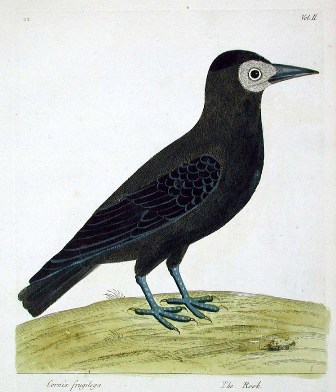
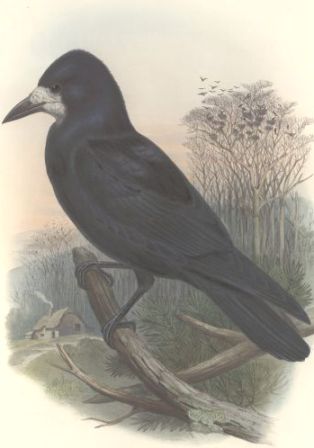
45 cm., 425 g., female 375 g., black with white face.
Where to find: —
Mainly Hawkes Bay, northern Wairarapa and Canterbury.
Poetry: —
The Cold Heaven
Suddenly I saw the cold and rook–delighting heaven
That seemed as though ice burned and was but the more ice,
And thereupon imagination and heart were driven
So wild that every casual thought of that and this
Vanished, and left but memories, that should be out of season
With the hot blood of youth, of love crossed long ago;
And I took all the blame out of all sense and reason,
Until I cried and trembled and rocked to and fro,
Riddled with light. Ah! when the ghost begins to quicken,
Confusion of the death–bed over, is it sent
Out naked on the roads, as the books say, and stricken
By the injustice of the skies for punishment?
— William Butler Yeats
Illustration description: —
Albin, Eleazar, Natural History of Birds, 1731–38.
Gould, John, Birds of Great Britain, 1862–73.
Reference(s): —
Heather, B., & Robertson, H., Field Guide to the Birds of New Zealand, 2000.
Oliver, W.R.B., New Zealand Birds, 1955.
Page date & version: —
Tuesday, 3 June 2014; ver2009v1