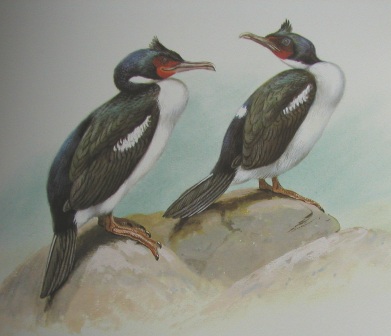
This shag is dimorphic, that is it has two colour phases or forms, one phase being white breasted like most of the pink footed shags, and the other black breasted, the bronze phase, giving rise to the belief that they are two separate species. The two morphs breed together indifferently. It is found in the southernmost parts of the South Island of New Zealand, from the Otago Peninsula south to the Foveaux Strait, and to Stewart Island/Rakiura, from which it takes its name. It is rare, with the population estimated at 1,600–1,800 breeding pairs. It is one of the blue-eyed shags, a group of closely related birds which all have a blue, purple or red ring around the eye - not a blue iris. This group are also all pink-footed.
According to Fleming, it is closely related to the King shag and the Chatham Island shag. "These shags ... all are quite closely related in morphology and behaviour, particluarly in their limited powers of flight and sedentary habit that keeps them close to their breeding stations. These characters have ensured that gene exchange between separate island groups occurs rarely, small variations become fixed, and subspeciation has been rapid. Stewart Island and King shags are separated by five hundred kilometres of South Island coast that seems to include suitable habitat, so the shags' disjunct ranges have perhaps been separated by extermination in the intervening region due to prehistoric human predation. This hypothesis gains some support from Falla's (1932) observation that Otago Peninsula specimens approach the King shag in their large size and distinct carunculation, as if a cline of continuous variation formerly linked the two races. At present their isolation seems complete, and the distinctive characters of the King shag seem to imply that some intervening South Island coasts - perhaps gravel beaches and an influx of fresh water from major rivers - are unsuitable for pink-footed shags."
Stewart Island shags breed colonially, on rocky headlands and islands, building a platform nest of twigs, seaweed and guano. Colonies are large enough to be strikingly visible, and are used year after year; there is a notable one on the northern shore of Taiaroa Head at the mouth of Otago Harbour.
They feed in coastal waters, rarely if ever being seen inland or far out to sea. It feeds on fish and marine invertebrates.
Members of the shag family belong to three groups, based on the colour of their feet: black, yellow or pink. Outside New Zealand, the black-footed shags are better known as cormorants. Pink-footed shags belong to the Leucocarbo genus. They are part of a group of cold-water shags found on islands in the Southern Ocean, on the Antarctic Peninsula and the south coasts of Australia and South America. They all feed at sea. The six New Zealand species are found nowhere else. They nest on rock rather than in trees, which are absent in many of their habitats.
Other common names: —
bronzed shag, Stewart shag
Description: —
Endemic bird
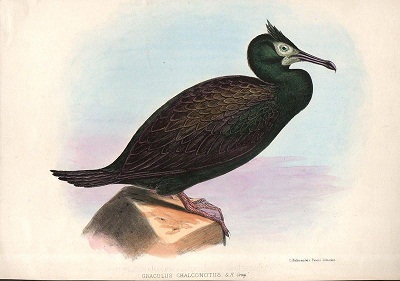
63cm, 2.25kg, like King shag but smaller, orange caruncles, pink feet.The species is dimorphic in appearance. Roughly half the individuals are mostly dark bronze, but with white patches, similar to the King Shag; the remainder are bronze all over. The two morphs breed together indifferently.
Where to find: —
South Island of New Zealand, from the Otago Peninsula south to the Foveaux Strait, and to Stewart Island/Rakiura.
Illustration description: —
Fleming, C., George Edward Lodge, The Unpublished Bird Paintngs, 1982.
Gray, George Robert & Sharpe, R. Bowdler. The Zoology of the voyage of HMS Erebus & Terror, Birds of New Zealand, E.W. Janson, London 1875. The revised edition of Gray (1846).
Reference(s): —
Oliver, W.R.B., New Zealand Birds, 1955.
Heather, B., & Robertson, H., Field Guide to the Birds of New Zealand, 2000.
Fleming, C., George Edward Lodge, The Unpublished Bird Paintngs, 1982.
Page date & version: —
Wednesday, 4 June 2014; ver2009v1