Walking along North Street in Greytown with my dog, always there are spur-winged plovers to be seen in the paddocks. There used to be two or three pairs but this winter I see just the one pair. I hope this is not a trend.
Travelling throughout New Zealand, especially through farmland, the one bird that one is most likely to see is the spur–winged plover, very often being harried by and, in turn, harrying a harrier hawk. However, spur–winged plovers did not used to be so widespread, the first pair recorded breeding at Invercargill airport in 1932. In spite of the heavy predation of their chicks by harrier hawks and our national propensity for using birds for target practice, their numbers have now become so great that there is talk of culling them. Not a good reason, I would think.
There are two well marked races of this bird; the smaller race, Vanellus miles novaehollandiae, originally just bred in the south–east of Australia but then extended its range to Tasmania and New Zealand. The other, northern, race, Vanellus miles miles, has extended its range from northern Australia to New Guinea.
Both races frequent wet grasslands but will readily adapt to man–made habitats such as pastures, sports grounds, airfields and even median strips on busy roads. Indeed, one will often see them on median strips while driving to Wellington. Somehow they seem to have worked out that their chicks will be safe there from cats and harrier hawks. Their liking for airports however, is not a good idea though as it leaves them open to some severe culling because of the fear of bird strike.
Breeding is between June and late November with the peak in August. Several clutches are laid each year. The nest is a scrape in the ground in rough open pasture, a flat wet area or on stony ground. The clutch of 1–4 brown eggs with darker blotches is incubated by both sexes for 30-31 days. The fledging period is 7–8 weeks.
The spur–winged plover feeds mainly on insects, worms and similar small invertebrates but will also eat seeds. Their main call is a is a loud, penetrating rattle, often heard at night which may explain why many people have grown to hate them.
Other common names: —
masked lapwing, masked plover
Description: —
Native bird
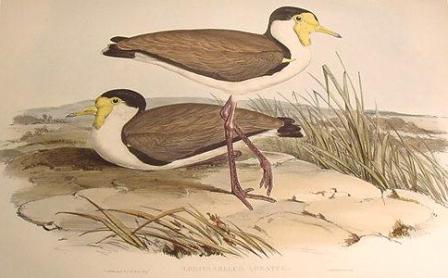
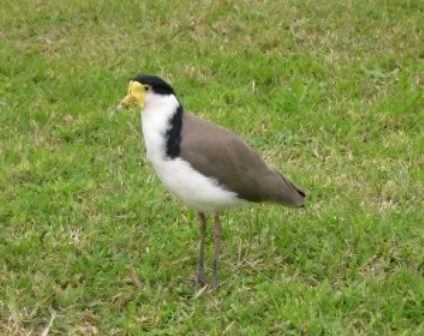
38 cm., males 370g., females 350 g., olive–brown above and white below. The crown, outer wing feather and sub–terminal tail band are black and the wing has a brown–tipped yellow spur at the “wrist”. Both races have large yellow wattles but in the northern race this feature is larger and extends both above and behind the eye. The south–eastern race has a broad black stripe going down the back of the neck and a wide black patch on its shoulders. Intermediate forms are known, especially where the range of the races overlap.
Where to find: —
Common and widespread.
Credit for the photograph: —
Rachel Sloan
Illustration description: —
Gould, John, Birds of Australia, 1840-48.
Reference(s): —
Heather, B., & Robertson, H., Field Guide to the Birds of New Zealand, 2000.
Oliver, W.R.B., New Zealand Birds, 1955.
Page date & version: —
Thursday, 5 June 2014; ver2009v1