

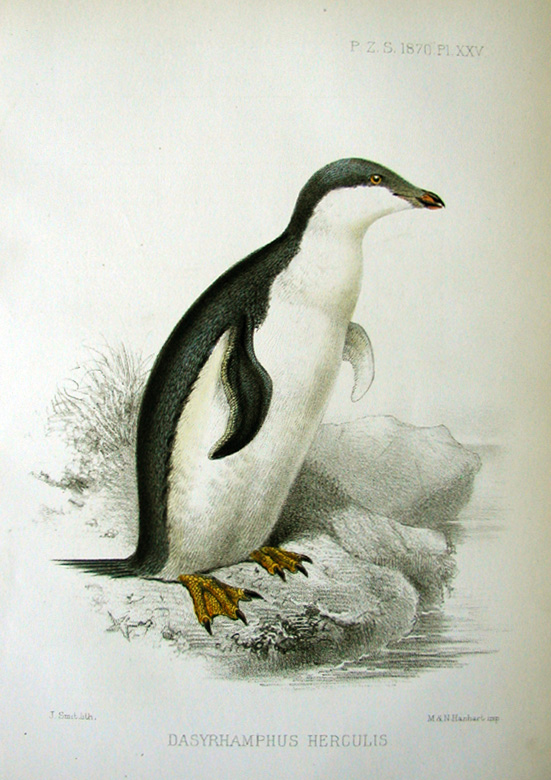
The Transactions & The Proceedings of the Zoological Society of London, 1835-1984.
T he small penguin species include the Adelie Penguin Pygoscelis adeliae, the Gentoo Penguin Pygoscelis papua, and the Chinstrap Penguin Pygoscelis antarctica.
Named after the wife of the French explorer Admiral Durmont d’ Urville, the Adelie is probably the most commonly studied of all the penguin species. Counts of Adelie penguins are being used to monitor changes to the Antarctic environment.
A rare visitor to the New Zealand mainland, the Adelie penguin inhabits the Antarctic continent and the surrounding waters within the limits of pack ice. Adelie penguins spend their lives, outside of the breeding season, at sea, resting on ice floes. Their diet is primarily krill with some fish.
Adelie penguins nest in large colonies of up to half a million birds. The breeding season is from November to February. Nests are small depressions lined with pebbles that are carefully selected and brought to the nest site. Nests are started by males at the beginning of the season and then added to by both birds after the pair is formed. Usually two eggs are laid, in rare cases, three. The incubation period of the first egg is 35 - 37 days; chicks hatch asynchronally. Both male and female parent share incubation and chick rearing duties. The downy grey and black chicks are fed regurgitated krill. Young are independent of the parents at about two months of age.
Skuas prey on eggs and chicks on land whilst Leopard seals are the primary predators of adult birds. Following films that have recorded Adelie penguins leaping en masse from the edge of the ice with Leopard seals lurking in the water below, researchers have found that adults are at greater risk when returning from trips out to sea. Gordon S. Court has written: “For long suspenseful moments, the chase of one Adelie continued underwater; rapid changes in the direction of the bubbles indicated that the seal was in hot pursuit. Suddenly, the zigzag changed to a straight line, an all-out test of speed with both animals rising, arcing, and resubmerging in syncrony. An Adelie penguin on land is an ungainly thing, but in water, it moves like a salmon and, when traveling fast, clears the surface every few seconds to breathe. To see an eleven–foot–long leopard seal, weighing perhaps 800 pounds, match this performance, stroke for stroke, is spectacular. The chase lasted for some minutes, long enough for four scientists working in different parts of the penguin rookery to look out to sea and watch the Adelie successfully outdistance the seal.” Source: Natural History, August 1996 (Gordon S. Court)
Adelie Penguin declines of around 50% in the last 30 years are thought to be driven by reduced krill density due to over harvesting, changing climate and the ensuing retreating sea ice, and increasing snow blizzards.

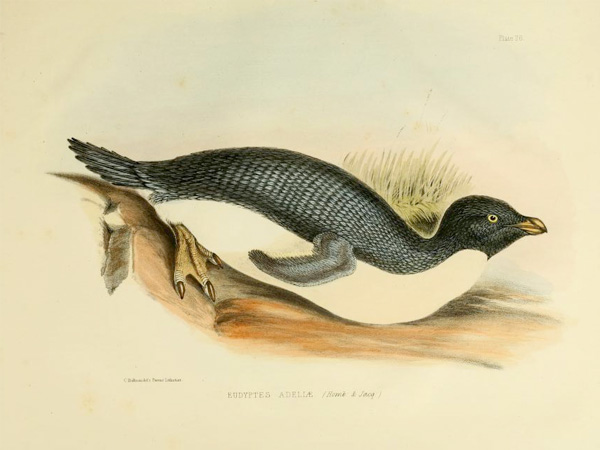
The zoology of the voyage of the H.M.S. Erebus & Terror, 1839-1943.
| Taxonomy | |
|---|---|
| Kingdom: | Animalia |
| Phylum: | Chordata |
| Class: | Aves |
| Order: | Sphenisciformes |
| Family: | Spheniscidae |
| Genera: | Pygoscelis |
| Species: | adeliae |
| Sub Species: |
Native bird
60-70 cm, 4-5 kg. top of the head, cheeks and throat black, the rest of the upper surface blue-black, flippers with a narrow white posterior border, tail black, conspicuous white eye ring, underparts white, no crest, bill brick red; juvenile similar to adult but throat white; nestling grey with dark head.
In New Zealand territory, the Ross Sea area of Antarctica, there are 34 breeding colonies. Cape Crozier has probably the second-largest Adelie colony in Antarctica.
»»» Population ecology of Adelie Penguins (in the Ross Sea, Antarctica)
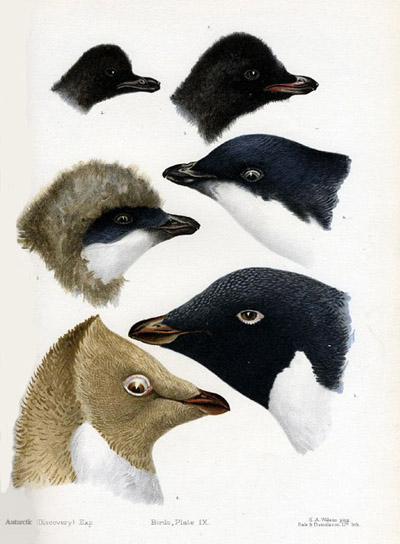
British National Antarctic Expedition, 1907-1912.
The Transactions & The Proceedings of the Zoological Society of London, 1835-1984.
The zoology of the voyage of the H.M.S. Erebus & Terror, under the command of Captain Sir James Clark Ross, during the years 1839 to 1843.
British National Antarctic Expedition, 1901-04. Robert Falcon Scott - Discovery Expedition, London, British Museum, 1907 to 1912.
Heather, B., & Robertson, H., Field Guide to the Birds of New Zealand, 2000.
Oliver, W.R.B., New Zealand Birds, 1955.
Saturday, 14 October, 2023; ver2023v1