

BACKGROUND
Banding of birds dates back to 1899 when a Christian Mortensen produced numbered aluminium bands, and used them to band storks, teal, starlings and other birds in Denmark. Banding or ringing is now common in many countries in the world, with millions of birds being banded yearly.
Banding of birds in New Zealand has been carried out since the late forties by the Wildlife Service of the Department of Internal Affairs (game birds and waterfowl) and since 1950 by the Ornithological Society of New Zealand in conjunction with the National Museum (all other birds).
[New Zealand's National Museum is now known as the Museum of New Zealand Te Papa Tongarewa]
In 1967 the two schemes were merged into the New Zealand National Bird Banding Scheme (NZNBBS). From then on, all bird banding was controlled by the Wildlife Service, where all records were kept, until the Department of Conservation took over the guardianship of the scheme on 1st April 1987.
Purpose of the database
The aim is to obtain accurate information about movements and habits. Apart from its purely scientific value, such knowledge is essential for effective conservation of native species, for management of game birds, and for the control of those which are considered pests.
Results
When this page was first published, back in April of 2003, over 1,150,000 birds of 230 different species had been banded throughout the New Zealand Region with around 25,000 birds being banded each year.
According to DOC the NZNBBS has now issued more than 2 million unique numbered metal bands to banders, and of the 1.6 million banded birds, there have been over 300,000 resighting and recovery records.
Recoveries of banded birds are bringing to light much information about the migrations, habits, lengths of life and causes of death of wild and hand reared New Zealand birds.
The success of the banding scheme depends, to a large extent, on the reporting of bands by members of the public who find them. Every band recorded adds another item of information and may even mean an entirely new discovery.
REPORT A SIGHTING
If you find a banded bird (alive or dead)
Apart from ducks and other game birds, which are shot for sport, no bird seen wearing a band should be harmed, for it may be under observation by the bander.
If any bird is caught alive and healthy, the number and address on its band should be carefully noted and the bird released again still wearing its band, as it may be recovered again.
The number on the bird’s band, the colour of the band, band found on left or right leg, the date, place, and circumstances of recovery should be reported to the Banding Office as soon as possible.
There are many other links to DOC, but the following provides a lot of useful, interesting and timely information about bird banding in New Zealand.
DOC BANDING INFORMATION & BAND ENTRY
One can also access the data input page from this link.
Plus a prticularly interesting aspect of this site are the links to past and present bird banding news letters -- (they are brilliant!).
DOC Banding Office Contact Details
Banding Office
Department of Conservation
PO Box 108
WELLINGTON 6140
email: [email protected]
Foreign bands
There are also foreign bird-banding schemes, with which NZ is in constant touch. Any foreign bands may be reported via the doc banding database:
or reported to the address on the band.
FALCON Bird Banding System
DOC has recently designed a new fit-for-purpose database and online interface to improve the data management function of the Banding Office - this management tool, called the FALCON Bird Banding System, went live in August 2020.
FALCON is an acronym for the components of the System: File Upload, Accessibility, Locality (mapping), Certification, Open-Source and Notification (communication).
It aims to be the single, accessible repository of New Zealand's bird banding data. However, access to this database is restricted to authenticated users. See the link below if you wish to apply.
To learn more about FALCON, visit here: FALCON
General Examples of data gathered
(no definitive date, probably circa 2003)
| Bird | Banded | Recovered | Distance (km) |
|---|---|---|---|
| Royal Albatross | Campbell Is. | South Atlantic | 10,000km |
| Cape Pigeon | Tory Channel | Wilks Land (Antarctica) | 3,530km |
| Sooty Shearwater | Cook Strait | Japan | 11,250km |
| Gannet | Cape Kidnappers | Western Australia | 5,470km |
| White Fronted Tern | Lake Ellesmere | Victoria, Australia | 2,750km |
| Antarctic Skua | Cape Hallet (Antarctica) | Japan | 12,900km |
| Red-billed Gull | Kiakoura | Auckland | 645km |
| Australasian Harrier | Hawke’s Bay | Invercargill | 970km |
| Mallard | Lake Tuakitoto | Adelaide, Australia | 3,000km |
| House Sparrow | Upper Hutt | Reporoa | 320km |
| Bird | Age in years |
|---|---|
| Finches | 6 – 8 |
| Flycatchers | 2 – 15 |
| Hedgesparrow | over 4 |
| Honeyeaters | 5 – 12 |
| House sparrow | 15 |
| Kea | over 18 |
| Magpies/Crows | 5 – 7 |
| Parakeets | over 10 |
| Silvereye | 10 |
| Starlings | 11 |
| Thrushs | 8 – 15 |
| Warblers | 4 – 6 |
| Wattlebirds | 10 – 16 |
| Wrens/Swallows | 2 – 7 |
| Kiwi | 10 |
| Albatross | 23 – 50 |
| Diving Petrel | 13 |
| Gannet | 30 |
| Penguin | 18 – 20 |
| Petrels/Shearwaters | 20 – 28 |
| Shags | 7 – 17 |
| Storm Petrel | 13 |
| Ducks/Teal | 6 – 25 |
| Swans/Geese | 29 – 30 |
| Harrier | 17 |
| Partridge/Quail/Pheasant | 9 – 15 |
| Rails | 8 – 13 |
| Gulls | 17 – 30+ |
| Knots/Stilts | 5 – 9 |
| Oystercatchers | 18 – 27+ |
| Plovers | 8 – 31+ |
| Skuas | 18 – 20 |
| Terns | 23 – 26 |
A cautionary note:
Concerns about banding are growing. It’s a complicated and controversial subject but there are reports that suggest that in many cases banding and other tracking instruments may be doing more harm to birds than we ever knew – in some cases more harm than good.
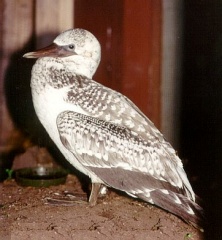
This juvenile gannet was banded at White Island in the Bay of Plenty, New Zealand. It is wearing band M59610 on its right leg. It was found in a paddock at Thornton, near Whakatane, Bay of Plenty, New Zeland. It weighted 1400g when found. After spending 13 days in care at Whakatane Bird Rescue it was released from the Ohope Spit, Bay of Plenty, on 8 March 1995 with a release weight of 2150g.
Information for this page is gathered and managed by Rosemary Tully.
Please email any additions or corrections to: [email protected];
The information for this page was originally researched prior to April 2003. The page has since been updated and contains further information and recent links to pages of relevance.
Rosemary would like to acknowledge the late Rod Cossee, Manager of the New Zealand National Banding Scheme, Department of Conservation, for his help in the establishment of this page.