

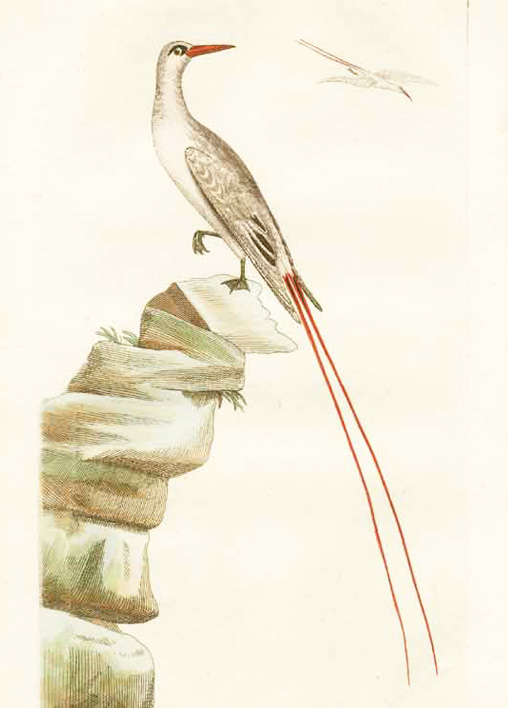
Red-tailed tropicbird, Vivarium Naturae, the Naturalist's Miscellany, George Shaw and Frederick Polydor Nodder, published between 1790-1813.
“The bill of the Amokura is a coral red, its plumage silky white, ever so faintly tinted with salmon. The setting of the tail shafts, however, is the arresting feature of the species. They are wide at the base but, the web suddenly contracting at a distance of two inches from the root, are produced as rigid bright red plumes, thirteen inches beyond the cuneiform tail. We watched the birds at every angle of flight, every rate of speed; not rarely they passed below us so swiftly that their plumes behind seemed but a diaphanous flash of strange brightness; sometimes more slowly in the sunlit air the hyaline red followed a ruddy haze, as a meteor’s radiance is shed astern. When floating with motionless wings, web, as well as shaft, were perfectly plain to the eye.”— So Guthrie-Smith described these birds on Meyer Island.
“Every nest on Meyer Island or rather every spot on which a nestling rested was overhung with pendant gahnia roots and dead debris. Each bird sat as much as might be, concealed from the sun, pressed close against bank or rock. I take it in fact that nests photographed by us were those of outliers unable completely to hide themselves from the strong tropic light. No eggs were seen, nor young birds less than four weeks old; the plumage of these nestlings white barred with black and as yet showing no tinge of pink or salmon. I must say I do like to be able to declare that I have actually touched the birds shown photgraphed; this a matter of no great difficulty, nor were our kindly advances repelled, a courtesy returned on our part — no feather stolen from its possessor.”
The red-tailed tropicbird, which the sailor calls the bo’s’n–bird and the Polynesians the amokura, or atavaké, is one of the more beautiful birds of the mid-Pacific. This medium sized white bird with its black eye marking and elegant long red tail streamers is relatively common.
The birds are more pelagic than other tropicbirds and are often seen far from land. They may be seen to dive with half folded wings to capture fish & squid.
Mated pairs have a characteristic hovering display flight and nest on ground on atolls or on coastal cliffs. They are extremely ungainly on land but agile in the air and sometimes appear to fly backwards.
According to Elsdon Best, the Amokura, the red-tailed tropicbird, was indeed a prize to the Maori of old, so high a value did he set on its long red tail-feathers. These and other plumes were prized as decorations, and also as valuable mediums in barter, when they would exchange for greenstone or some other coveted valuable. After easterly gales it is said Maori systematically searched the coast for wrecked birds for it is only a rare visitor to the mainland islands of New Zealand.

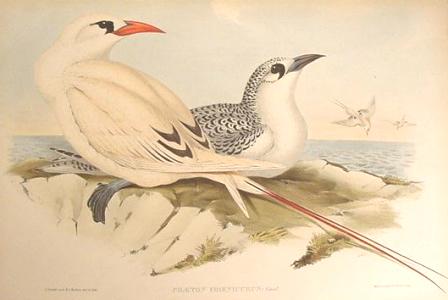
Red-tailed tropicbird from John Gould’s Birds of Australia, (1840-1848).
| Taxonomy | |
|---|---|
| Kingdom: | Animalia |
| Phylum: | Chordata |
| Class: | Aves |
| Order: | Pelecaniformes |
| Family: | Phaethontidae |
| Genera: | Phaethon |
| Species: | rubricauda |
| Sub Species: | roseotinctus |
Tawake, Ko’ae ’Ula, bosun bird
Native bird
46cm (plus up to 40cm for tail streamers); 800 g. Adult general colour pinkish white with black feather shafts on primaries, tertials and tail; black patch through eye; bright red bill; tail streamers red. Juvenile lacks tail streamers and is barred black above; black or dull red bill.
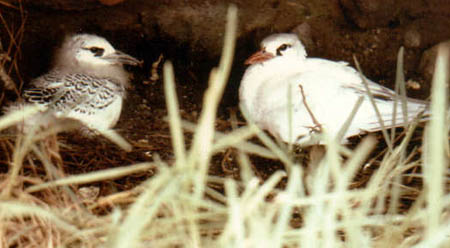
Breed on Lord Howe, Kermadec, and Norfolk Islands. A few may be seen off the Hauraki Gulf or Northland.
George Shaw and Frederick Polydor Nodder, Vivarium Naturae, the Naturalist's Miscellany, published between 1790-1813 in monthly parts.
John Gould’s Birds of Australia, (1840-1848).
Guthrie-Smith, H., Sorrow and Joys of a New Zealand Naturalist, 1936.
Best, Eldson, Forest Lore of the Maori, 1942.
Heather & Robertson Field Guide, 2000.
Friday, 11 August, 2023; ver2023v1