

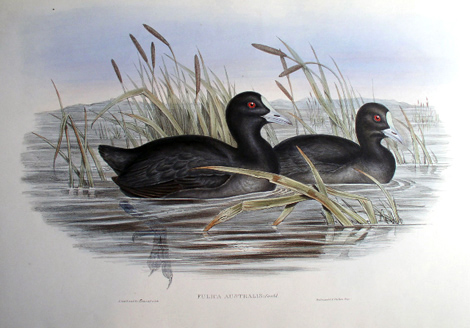
From John Gould's Birds of Australia, 1840-48.
T he coot is represented by similar species with virtually the same habits throughout the Palaearctic region from Iceland to Japan, and in most other parts of the world. An African species, F. cristata, is easily distinguished by two red knobs on its forehead. The Australian and North American species, F. australis and F. americana have a great resemblance to the Eurasian bird; but in South America half-a-dozen or more additional species are found which range to Patagonia, and vary in size, one F. gigantea being of considerable magnitude. The remains of a very large species F. newtoni were discovered in Mauritius, where it must have been a contemporary of the dodo, but like that bird is now extinct. F. chathamensis, the New Zealand coot, is also extinct.
The Australian sub species was a rare vagrant in New Zealand until the 1950s when they moved across the Tasman and began to breed here. It is now widespread and numerous on certain lakes, especially around Rotorua in sheltered bays fringed with raupo (catstail or bulrush). Numbers seem to be increasing.
In New Zealand, eggs are laid from August to February and often two broods are raised. The nest is a large mass of water weeds, piled together among rushes or raupo in the water or on the margin, and not infrequently contains as many as ten eggs. The young, when first hatched, are beautiful little creatures, clothed in jet-black down, with their heads of a bright orange-scarlet, varied with purplish-blue. This brilliant coloring is soon lost, and they begin to assume the almost uniform sooty-black plumage which is worn for the rest of their life; but a characteristic of the adult is a bare patch or callosity on the forehead, which being nearly white gives rise to the epithet bald often prefixed to the birds name. Diet is mainly vegetarian, which they obtain mainly by diving.
Coots may form large flocks out of the breeding season and are not unlike dabchicks in the way they skitter across the water.
The word coot, in some parts of England pronounced cute, or scute, is of uncertain origin but may have something to do with the sound of its piercing loud call.

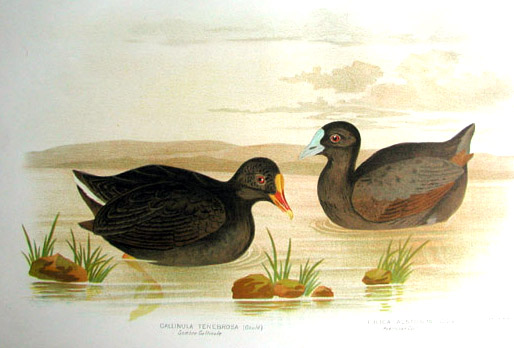
From The Birds of Australia, 1887-1891. G.J. Broinowski.
Gallinula tenebrosa, (Sombre Gallinule); Fulica australis (Australian Coot)
| Taxonomy | |
|---|---|
| Kingdom: | Animalia. |
| Phylum: | Chordata. |
| Class: | Aves. |
| Order: | Gruiformes (Ralliformes). |
| Family: | Rallidae. |
| Genera: | Fulica. |
| Species: | atra. |
| Sub Species: | australis |
Eurasian coot, bald coot
38 cm, males 570 g, females 520 g, sooty-black with white patch on forehead.
Prefer shallow reed fringed lakes. Widespread and increasing as they colonise new lakes.
Gould, John, Birds of Australia, 1840-48.
Broinowski, G.J. , The Birds of Australia, 1887-1891.
Heather, B., & Robertson, H., Field Guide to the Birds of New Zealand, 2000.
Oliver, W.R.B., New Zealand Birds, 1955.
Sunday, 30 July, 2023; ver2023v1