

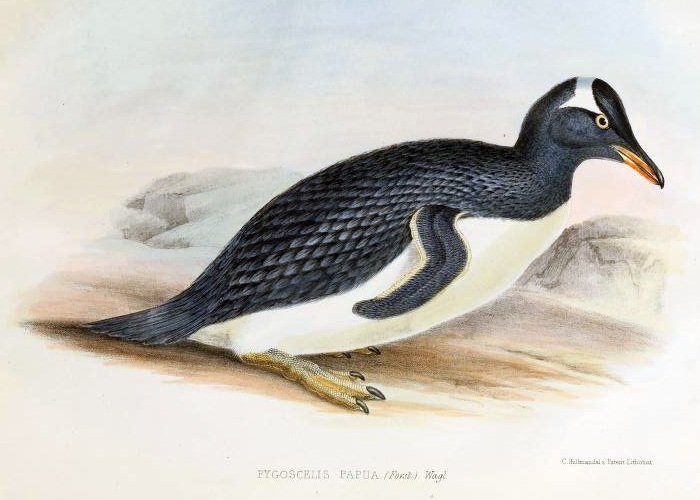
The Zoology of the voyage of HMS Erebus & Terror. Birds of New Zealand., E.W. Janson, London 1875. The revised edition of Gray (1846).
The Gentoo penguin was first discovered at the Falkland Islands whence specimens were described by Forster in 1781. In the New Zealand region it was first collected by the American Exploring Expedition under Commander Wilkes at Macquarie Island where, in 1840, the Flying Fish, one of the five ships of the expedition, called and landed a boat's crew: this according to Oliver.
The small penguin species include the Adelie Penguin Pygoscelis adeliae, the Gentoo Penguin Pygoscelis papua, and the Chinstrap Penguin Pygoscelis antartica.
Chinstrap, Gentoo, and Adelie penguins all belong to the Pygoscelis genus of penguins, which means brush-tailed or long-tailed penguins. Of the three species, the Gentoos have the most prominent tails, in which long, stiff feathers stick out behind as they walk. All three of these species are about the same size.
Chinstrap and Gentoo penguins both penetrate south of the Antarctic Convergence, but their breeding grounds are further to the north. Chinstraps breed on the islands around the continent and some are found on the islands close to the Antarctic Convergence. Gentoos have a wider range than Chinstraps, and they can be found between 52 degrees South latitude in the Falklands and 65 degrees South latitude on the frozen Antarctic Peninsula. The closest breeding colony to New Zealand is on Macquarie Island. Gentoos that live in the more southerly latitudes tend to be smaller in size, and they also have smaller bills, flippers, and feet. This is probably an adaptation to the colder climate. Gentoos are the fastest swimmers of all birds.
Gentoos are the least abundant, or the more threatened, of the Pygoscelis penguins … with only 300,000 to 350,000 individuals.

| Taxonomy | |
|---|---|
| Kingdom: | Animalia |
| Phylum: | Chordata |
| Class: | Aves |
| Order: | Sphenisciformes |
| Family: | Spheniscidae |
| Genera: | Pygoscelis |
| Species: | papua |
| Sub Species: |
Aptenodytes antarctica
Native bird
75 cm., 5.5.kg., white front, small white triangle above each eye, rest of their body is black.,feet are yellow-orange, bill is reddish-orange.
Circumpolar, breeding on Macquarie Island.
Gray, George Robert & Sharpe, R. Bowdler. The Zoology of the voyage of HMS Erebus & Terror. Birds of New Zealand., E.W. Janson, London 1875. The revised edition of Gray (1846).
Heather, B., & Robertson, H., Field Guide to the Birds of New Zealand, 2000.
Oliver, W.R.B., New Zealand Birds, 1955.
Saturday, 14 October, 2023; ver2023v1