

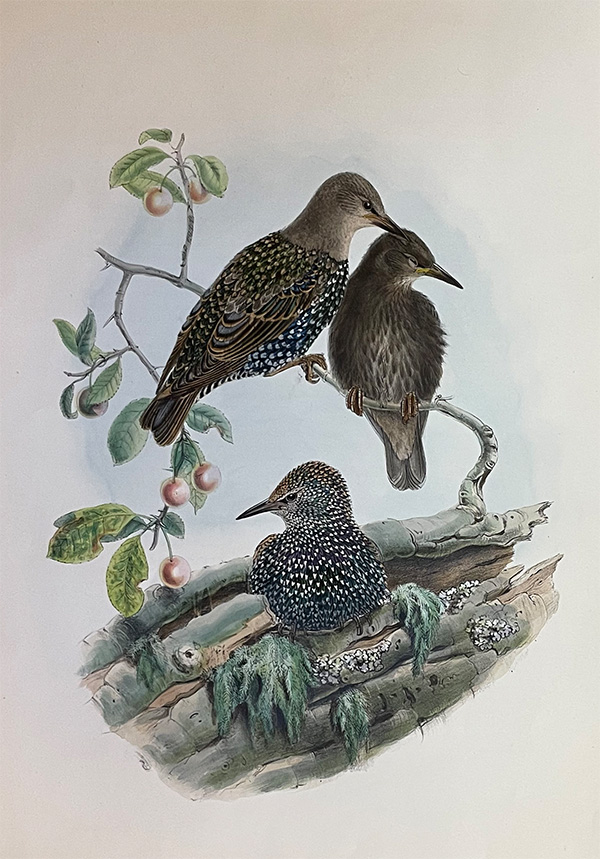
From John Gould's Birds of Great Britain, 1862–73.
The starling gets its name from the tiny white stars that gleam, only in summer, against its glistening dark feathers.
For many years on my farm in the eastern Bay of Plenty, starlings would nest in the roof of the office building until the arboreal rat, rattus rattus, found them there and cleaned them out. They never returned there to nest. Their waddling walk forever reminds me of Charlie Chaplin.
It has long been said that homesick settlers introduced birds into New Zealand for purely sentimental reasons. Sentimentality was indeed a factor with such birds as the skylark but the main reason for their introduction was far more practical.
With the wholesale destruction of the bush to make farmed land, the ecology was so disrupted that the country was overwhelmed by plagues of insects which, to use the words in an old agricultural bulletin, “crawled over the land in vast hordes. The gathering of the caterpillars was a sight that caused consternation to agriculturists. They came not in regiments and battalions but in mighty armies, devouring crops as they passed along and leaving fields as bare as if seed had not been sown”. One of the few weapons the farmers had was to drive flocks of sheep over the armies of caterpillars. “In places large ditches were dug to stop the creatures progress. Some of the native birds performed good service by eating the insects. Prominent among these were gulls, terns, kingfishers, oystercatchers, native larks, white–eyes, fantails, bellbirds and grey warblers. At first the kingfishers seemed to increase rapidly with agriculture and were regarded for a time as the agriculturists’ best friends. The native birds, however, would not dwell with men, and when the bush was destroyed in the vicinity of settlement they retreated further back, and only visited the insect laden fields occasionally.”
It was for this reason that the settlers turned their attention to the insect eating birds. The issue was considered carefully. The introduced birds would have to possess three qualifications: they would have to be able to eat both insects and seeds, otherwise they would not survive the winters; they must be non-migratory, otherwise the time and money spent on their acclimatization would be wasted; and they must be prolific breeders, so that they should multiply and soon overcome insect pests.
As with several other species, the Nelson Acclimatisation Society was the earliest to introduce the starling to New Zealand, a batch of 17 birds being imported about 1862, says Oliver. During the following twenty years, large numbers were landed and released in various parts of the country by acclimatisation societies and private individuals. The species everywhere quickly became established, even as far as the Kermedec and Macquarie Islands.
Starlings are considered both noxious and useful on the New Zealand agricultural scene. Orchardists consider it to be a pest but in pastoral areas this species is beneficial as it preys upon grass grub, Costelytra zealandica, and other pests. From the 1906 volume of the Transactions and Proceedings of the NZ Institute, "There is hardly any limit to the good words said of the starling. It is frequently described as the only introduced bird worth having. It is found in nearly all parts of the colony, and its arrival in a new district is welcomed by all who are engaged in agriculture. Large numbers of farmers erect nesting-boxes in order to encourage it to come about their farms. Besides eating insects, it does a great deal of good by destroying larks' eggs and eating the ticks on sheep. Many farmers look upon this bird as being the only true insectivorous bird introduced into this colony. Somewhat alarming stories are told by quite a large number of correspondents, however, about the starling having taken to devouring fruit and even grain."
The food of the starling in the main consists of insects but also fruit, grain, eggs of ground breeding birds, and nectar from flowers. Flax, kowhai and rata are among the species visited for their nectar. Starlings may be seen feeding on the shore among caste up seaweed in association with pipits, gulls, sparrows and rock pigeons.
Any site that will hold a nest and give some protection from the weather is good enough for the starling, cliffs, holes in trees, dense vegetation, buildings, chimney pots. The nests are roughly built of grass and lined with feathers. The breeding season is mainly from September to November. The eggs take about thirteen to fourteen days to incubate.
During the winter, the starling resorts in immense numbers to certain roosting places for the night. These are often small outlying islands, such as Tiritiri Matangi, or plantations of gums or pine trees.
Starlings have diverse and complex vocalizations, and have been known to imbed sounds from their surroundings into their own calls, including car alarms, and human speech patterns. The birds can recognize particular individuals by their calls, and are currently the subject of research into the evolution of human language.

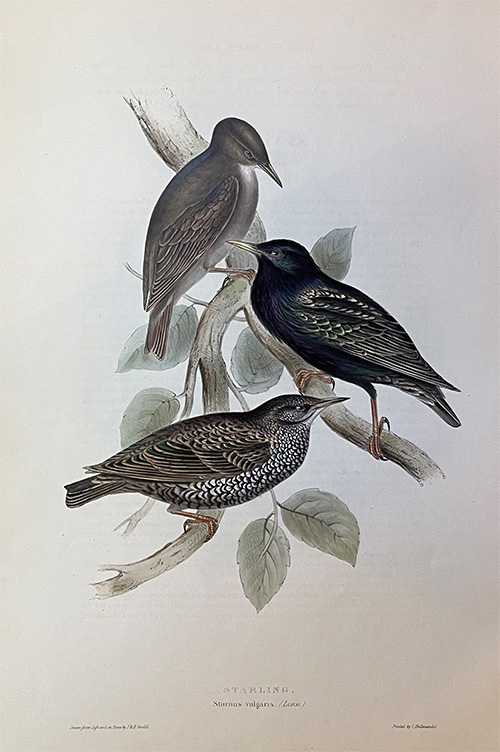
From John Gould's Birds of Europe, 1832–37.
| Taxonomy | |
|---|---|
| Kingdom: | Animalia |
| Phylum: | Chordata |
| Class: | Aves |
| Order: | Passeriformes |
| Family: | Sturnidae |
| Genera: | Sturnus |
| Species: | vulgaris |
| Sub Species: |
stare, stareling
Introduced bird
21 cm., 85 g., breeding adult glossy black with purple sheen on head and breast, green on wings and buff spotting on abdomen, yellow bill, non breeding bill dark. They waddle when they walk.
Widespread and common.
The bees build in the crevices
Of loosening masonry, and there
The mother birds bring grubs and flies.
My wall is loosening; honey-bees,
Come build in the empty house of the stare.
We are closed in, and the key is turned
On our uncertainty; somewhere
A man is killed, or a house burned,
Yet no clear fact to be discerned: honey-bees
Come build in the empty house of the stare.
A barricade of stone or of wood;
Some fourteen days of civil war;
Last night they trundled down the road
That dead young soldier in his blood:
Come build in the empty house of the stare.
We had fed the heart of fantasies,
The heart’s grewn brutal from the fare;
More substance in our enmities
Than in our love; O honey-bees,
Come build in the empty house of the stare.
The Stare’s Nest by My Window: Meditations in Time of Civil War
— William Butler Yeats 1865–1939
When he lies asleep,
And in his ear I’ll holla ‘Mortimer!’
Nay,
I’ll have a starling shall be taught to speak
Nothing but ‘Mortimer,’ and give it him,
To keep his anger still in motion.
— Shakespeare [1st Henry IV – I, 3]
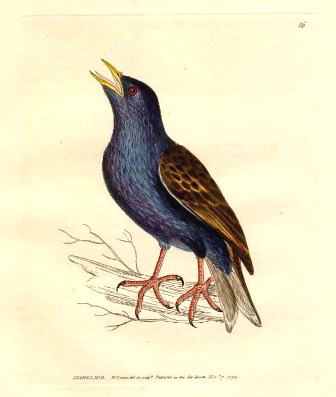
Starling from william Lewin's Birds of Great Britain, 2nd edition, 1794–1801.
Gould, John, Birds of Great Britain, 1862–73.
Gould, John, Birds of Europe, 1832–37.
Lewin, William, Birds of Great Britain, 2nd edition, 1794–1801.
NZ Department of Agricultural Bulletin No.16, 1907.
Heather, B., & Robertson, H., Field Guide to the Birds of New Zealand, 2000.
Oliver, W.R.B., New Zealand Birds, 1955.
Friday, 1 September, 2023; ver2023v1