

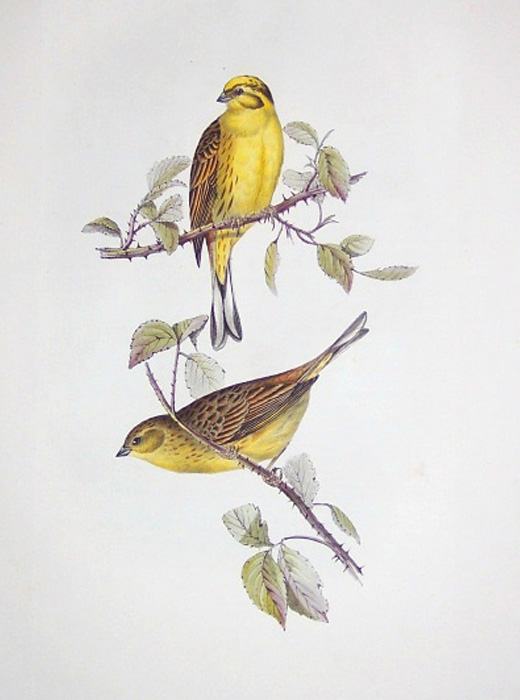
John Gould, Birds of Europe, 1832–37.
Feeding out hay to cattle during the winter on my farm in the eastern Bay of Plenty, many years ago, would draw large flocks of yellowhammers. I also used to see very many of them while living around Ohiwa harbour where the grasses were left to grow rank and seed in our very large four acre lot, but here in the Wairarapa I see them only occasionally on my country walks out of town. Now that farmers make shrink wrapped silage rather than hay, it would seem that yellowhammers have declined significantly.
I never see them here in the backyard in Greytown. Chaffinch, greenfinch and goldfinch, turn up here but never the yellowhammer, even though I put out seed bells for the birds. It leaves me wondering about what they eat that is different from our finches. However one does see them in urban environs when grass seed has been sown, even though coated with what one presumes to be some repellant or poison. By way of an experiment, I think I will buy some grass seed and see if I am able to attract them to the back yard.
The yellowhammer was included in the importation made by the Nelson Acclimatisation Society in 1862. It was subsequently liberated in Auckland, Canterbury and Otago and quickly became established throughout the country. It is probably still more abundant here in New Zealand now than in Europe where it is in serious decline and is categorised as a Red List species.
The male yellowhammer is a very attractive, often bright yellow bird, while the females and juveniles to the untrained eye look a bit like sparrows.
According to Oliver, the yellowhammer's grain eating habits make it one of the more harmful birds introduced to New Zealand.
I have noticed that visiting birders often mistake the yellowhammer for our own endemic yellowhead which is confined to forest, mainly beech, of the South Island and is a very rare bird indeed. The yellowhammer is confined to the open country and is rarely, if ever seen in the New Zealand forest or bush.

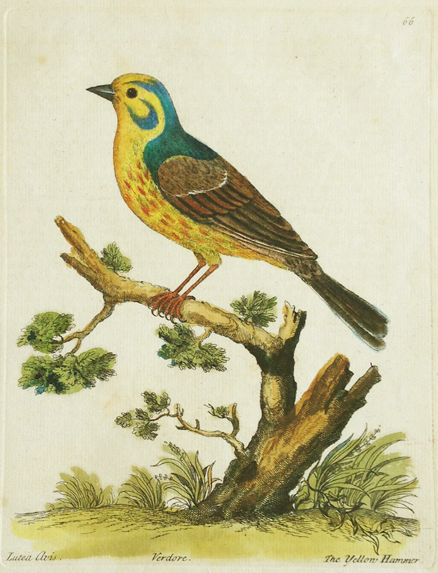
Yellowhammer from Eleazar ALBIN's The Natural History of Birds, 1735-50.
| Taxonomy | |
|---|---|
| Kingdom: | Animalia |
| Phylum: | Chordata |
| Class: | Aves |
| Order: | Passeriformes |
| Family: | Emberizidae |
| Genera: | Emberiza |
| Species: | citrinella |
| Sub Species: |
Yellow bunting, yellow yowley, yellow yeldrin, yellow yoldrin, yellow yite, yeldrock, yolkring, yoit, skite, goldie, yellow amber, yellow ring, scribble lark, scribbler.
Introduced bird
16 cm., 27 g., yellow bird with reddish brown upperparts, streaked with darker brown; this distinguishes it from the cirl bunting which has a greenish rump; male has bright yellow head and underparts, the female is more heavily marked with brown streaks., the juvenile is similar to the female.
Widespread and common.
Yellowhammer
LINK to the Yellowhammer NEST Page
Poetry: —
Five eggs, pen scribbled o’er with ink their shells,
Resembling writing scrolls, which Fancy reads
As Nature’s poesy and pastoral spells —
They are the yellowhammer’s and she dwells
Most poet like, ’mid brooks and flowery weeds.
— John Clare
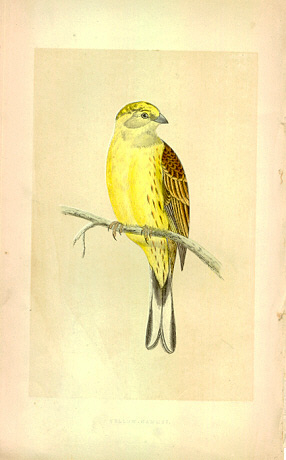
From A History of British Birds, 1st ed, 1851-57
John Gould, Birds of Europe, 1832–37.
Eleazar Albin, The Natural History of Birds, (1731-38).
A History of British Birds, 1st ed, 1851-57 Reverend Francis Orpen Morris (editor), Benjamin Fawcett (engraver).
Heather, B., & Robertson, H., Field Guide to the Birds of New Zealand, 2000.
Oliver, W.R.B., New Zealand Birds, 1955.
Tuesday, 5 September, 2023; ver2023v1